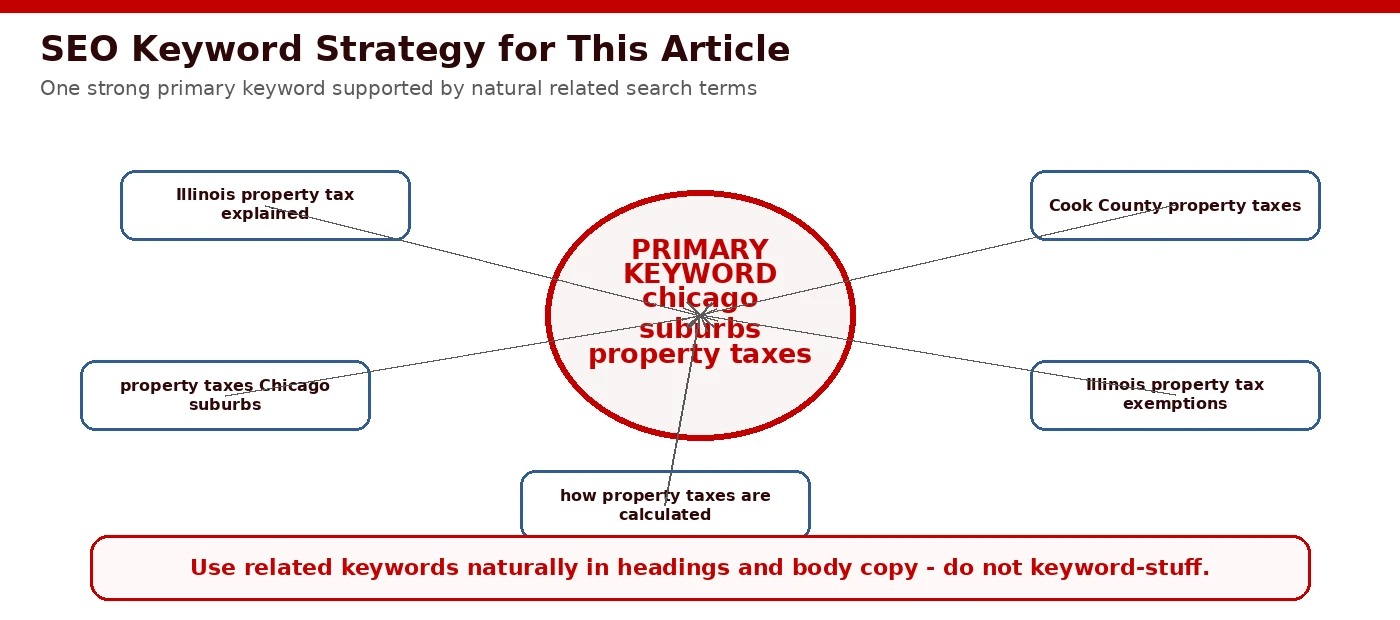




Property Taxes in the Chicago Suburbs Explained: A Simple 2026 Guide
A Grounded, Step-by-Step Educational Guide to Assessed Value, EAV, Homestead Exemptions, Cook County Rules, Reassessments, and Monthly Affordability
Educational Property Tax Disclaimer
This guide is published strictly for general educational and homebuyer planning purposes. It does NOT constitute legal, tax, lending, appraisal, or financial advice. Illinois property assessments, exemptions, tax rates, payment calendars, and appeal procedures are parcel-specific and subject to change. Always verify current, property-specific tax records directly with the applicable county assessor, county treasurer, local taxing districts, real estate attorney, or certified tax professional.
You find two homes in the northwest suburbs. Both have a listing price of $400,000. They may sit only two miles apart in what feels like the same general neighborhood—yet when you look at their annual property-tax bills, one pays $6,800 while the other pays $11,200.
How can two homes with the exact same purchase price carry such dramatically different ongoing carrying costs?
The answer lies in how chicago suburbs property taxes are structured. Illinois does not utilize one flat statewide residential property-tax rate. Property taxes are strictly local, parcel-specific obligations determined by a multi-step calculation involving fair market valuation, statutory assessment levels, state equalization, qualifying homeowner exemptions, and the annual budget levies of local public taxing bodies.
The Fundamental Rule
“Purchase price alone does NOT determine your property-tax bill. Illinois property taxes are parcel-specific and local.”
Before writing an offer, buyers must inspect the parcel’s Equalized Assessed Value (EAV), the seller’s current exemptions, the assigned taxing districts, and recent reassessment history.
The Illinois Property Tax Sequence
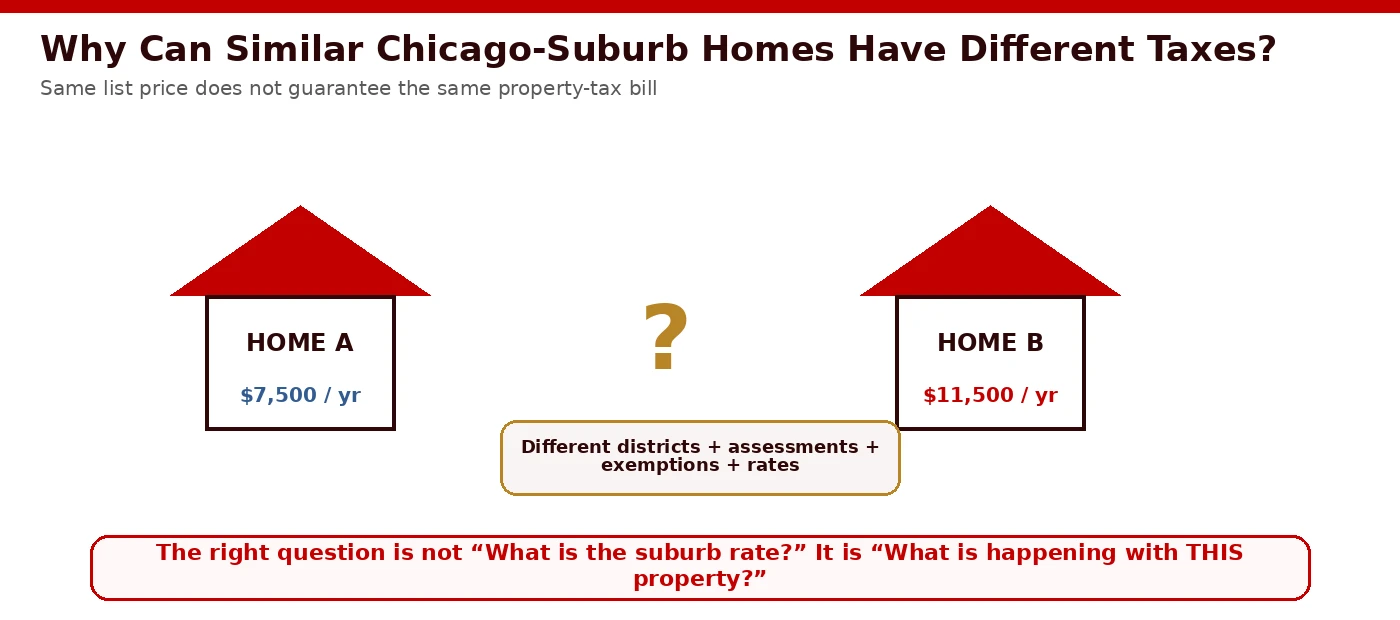
Why Do Property Taxes Feel So Complicated in the Chicago Suburbs?
Two similar homes can have very different tax bills—and the reason is usually local.
Homebuyers relocating from states with flat property tax systems (such as California’s Proposition 13 or Florida’s Save Our Homes cap) are often bewildered by Illinois real estate taxes. In Illinois, property taxes are not calculated by taking your purchase contract price and multiplying it by a single fixed county percentage.
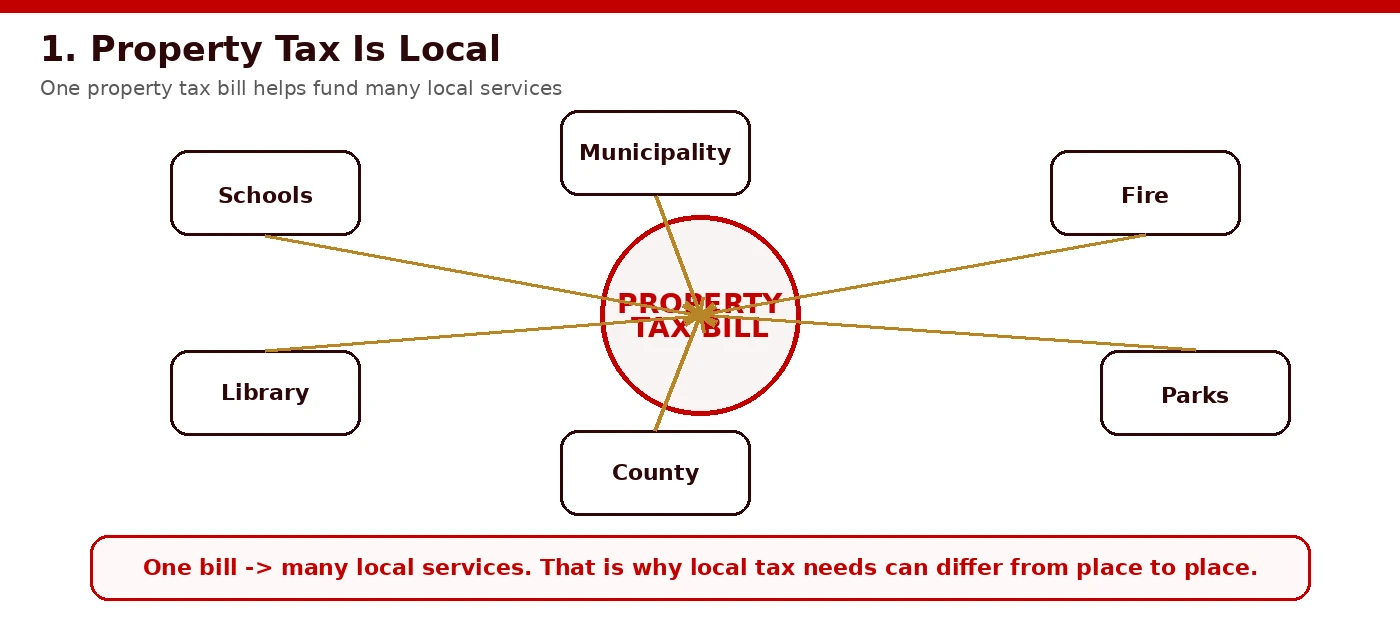
Instead, every residential parcel in Chicagoland belongs to a unique combination of overlapping governmental taxing bodies. Your annual tax bill is the sum total of separate financial levies required by:
- Local Public School Districts: Unified school districts or separate elementary (K-8) and high school (9-12) districts (consistently the largest single line item).
- Community College District: Local community college operational funding (such as Harper College, Oakton College, or College of DuPage).
- Municipal Government: Village or City administration, local police, public works, street lighting, and snow removal.
- County Government: County administration, regional court systems, county health departments, and forest preserve districts.
- Township Government: Local road maintenance, township general assistance, and local assessor administrative funding.
- Park District & Library District: Municipal parks, community recreation centers, public pools, and public library facilities.
- Fire Protection or Sanitary District: Where fire protection or water reclamation is administered by a special district rather than the municipality.
1. Property Tax Is a Local Tax
DecentralizedWhy Chicago suburbs property taxes vary dramatically from one address to the next.
According to comprehensive guidance from the Illinois Department of Revenue (IDOR Publication PTAX-1004), the State of Illinois does not impose, collect, or retain any general real estate property tax. Property taxes are strictly authorized by the Illinois General Assembly to be levied locally by local units of government to fund local community operations.
Because there are approximately 6,000 distinct local taxing districts across the State of Illinois—more than any other state in the nation—the exact tax burden depends entirely on the tax base, debt obligations, and approved levies of the specific districts that encompass your individual parcel.
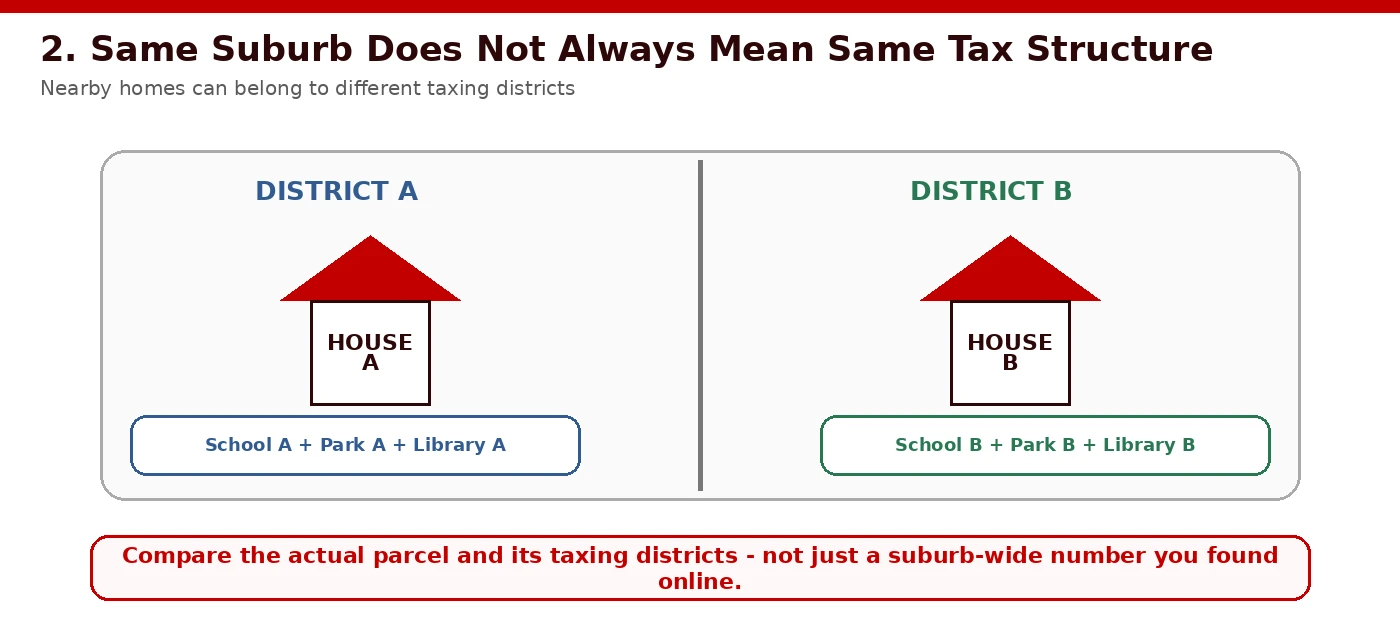
2. There Is No Simple “Chicago Suburbs Property Tax Rate”
Do not rely on one generic percentage for an entire suburb or zip code.
Homebuyers frequently ask questions like: “What is the tax rate in Schaumburg?” or “What is the tax rate in Arlington Heights?”
In reality, a single suburban village often spans multiple townships, multiple elementary school districts, and multiple high school districts. For instance, in our Schaumburg vs Hoffman Estates comparison or our guide to comparing Chicagoland property taxes, parts of Hoffman Estates feed into District 54 / District 211, while other sections feed into School District U-46 or District 300.
Because each school district sets its own annual tax levy based on student enrollment, capital debt, and operational budgets, two homes within the exact same village boundaries can experience noticeably different composite tax rates.
3. How Are Property Taxes Calculated in Illinois?
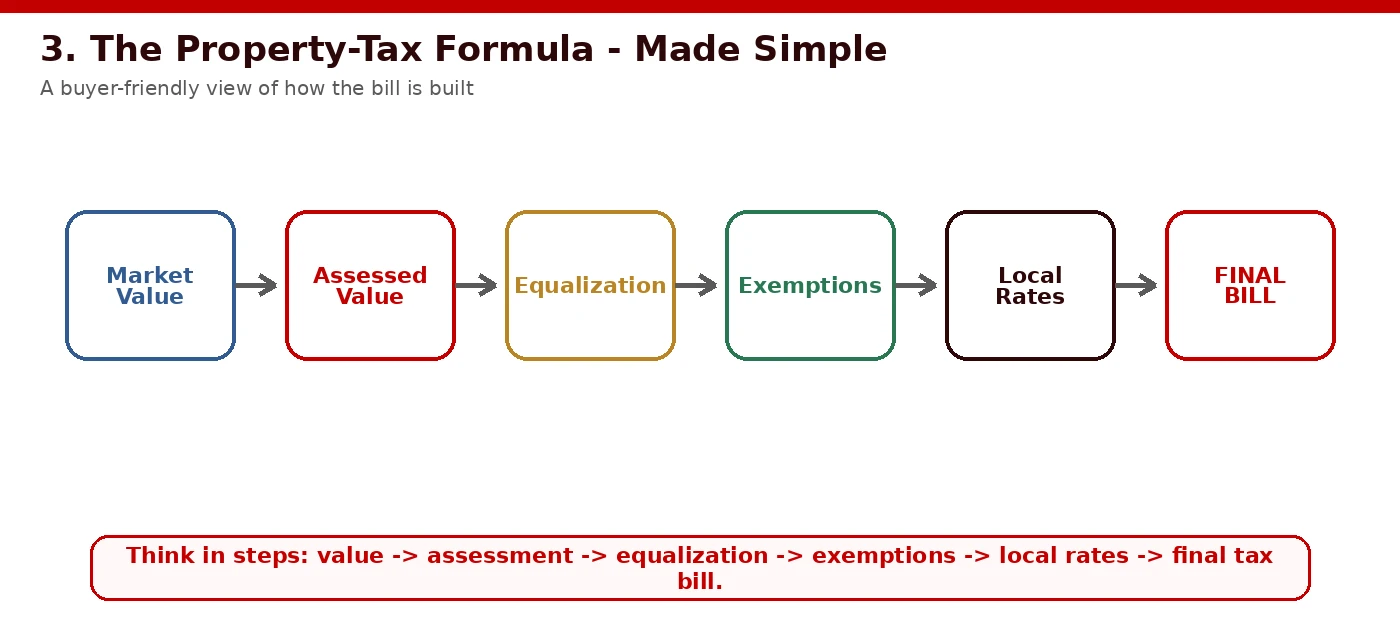
The FormulaA step-by-step buyer-friendly property tax formula.
While the administrative machinery involves statistical sales ratios and budgetary extensions, the calculation for an individual residential homeowner flows through five defined milestones:
Step 1: Fair Market Value
The local county assessor’s estimate of what your home would sell for in an arm’s-length market transaction.
Step 2: Assessed Value
Statutory percentage applied to market value: 10% in Cook County; 33 1/3% in all other 101 Illinois counties.
Step 3: State Equalization (EAV)
Assessed value is multiplied by the state equalization factor (multiplier) to establish Equalized Assessed Value.
Step 4: Subtract Eligible Exemptions
Qualifying reductions (Homeowner, Senior, Disability) are subtracted directly from EAV to yield Taxable EAV.
Step 5: Apply Composite Local Tax Rate
Taxable EAV is multiplied by the combined tax rates of all overlapping districts serving your parcel to generate the final tax bill.
4. Market Value Is Not the Same as Assessed Value
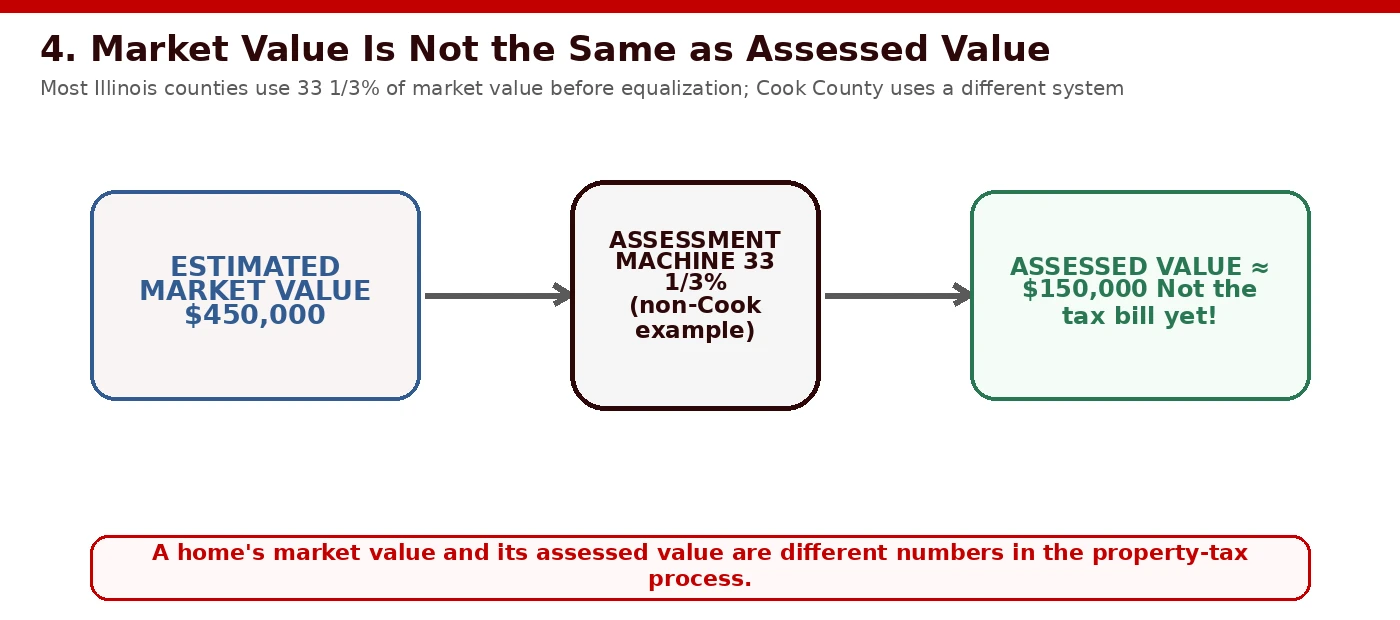
The number on an MLS listing sheet is not the number used directly as your tax base.
A common beginner mistake is looking at an assessment notice that says “Assessed Value: $50,000” and assuming the county believes the house is only worth $50,000.
Under the Illinois Property Tax Code (35 ILCS 200/9-145), real property outside Cook County is assessed at 33 1/3% (one-third) of its fair cash market value. Therefore, a home with a fair market value of $450,000 in Lake County or DuPage County receives an initial assessed value of approximately $150,000.
Illustrative Example (Non-Cook Collar Counties)
Simple educational calculation using statutory 33.33% assessment level:
Note: This $150,000 assessed value is not the tax bill. State equalization, eligible exemptions, and local taxing district rates still apply before the dollar amount is determined.
5. Cook County Property Taxes Use a Different Assessment System
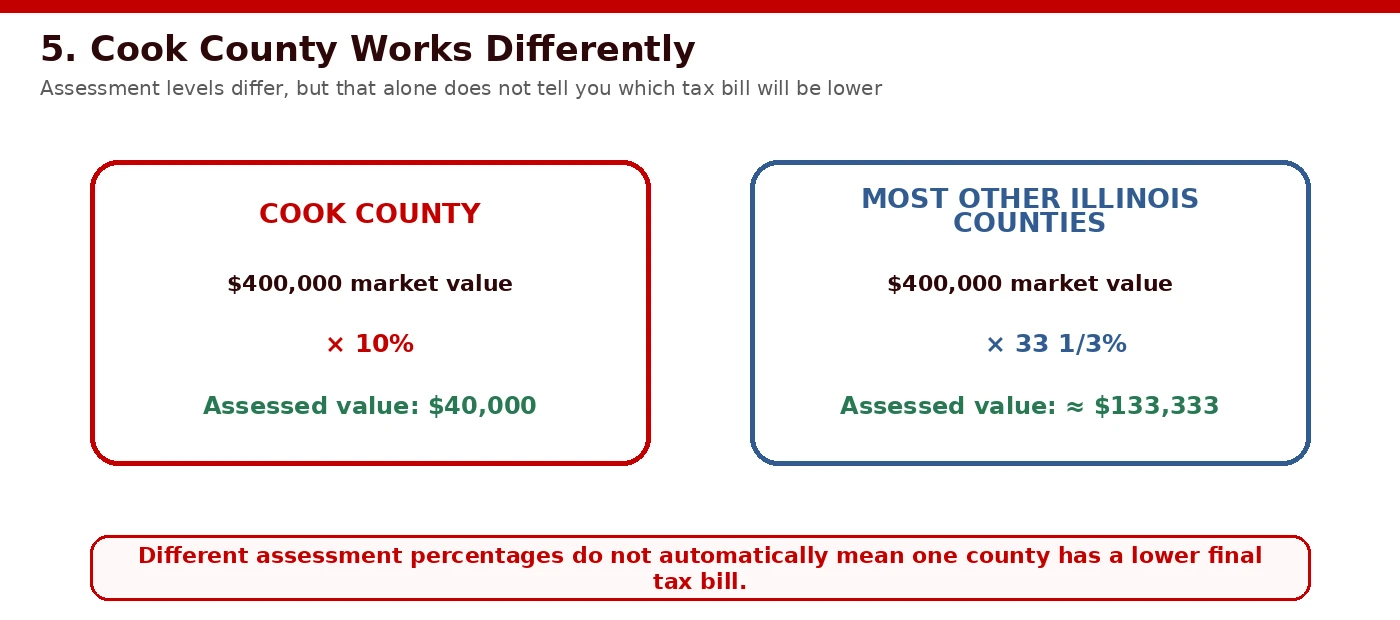
Cook County 10%Residential property in Cook County is assessed at 10% of market value.
Cook County is the sole county in Illinois permitted by the Illinois Constitution to classify real property into distinct categories with different assessment levels. Under the Cook County Real Property Assessment Classification Ordinance, residential real estate (Class 2) is assessed at 10% of market value, while commercial and industrial properties (Class 5) are assessed at 25%.
In Cook County, a residential home with an estimated market value of $400,000 receives an initial assessed value of just $40,000 ($400,000 × 10%).
Cook County vs. Collar Counties: Assessment Comparison
| Feature | Cook County | Collar Counties (Lake, DuPage, Will, Kane) |
|---|---|---|
| Residential Assessment Level | 10% of market value (Class 2) | 33 1/3% (one-third) of market value |
| State Equalization Multiplier | Significantly > 1.0 (typically ~2.7 to ~3.0+) | Typically near 1.0000 |
| Reassessment Frequency | Triennial (once every 3 years) | Quadrennial (once every 4 years) + annual revisions |
| Billing Structure | Installment 1 = 55% of prior year (due ~March); Installment 2 = actual balance (due summer/fall) | Two equal installments (typically due in June and September) |
6. What Is Equalized Assessed Value (EAV)?
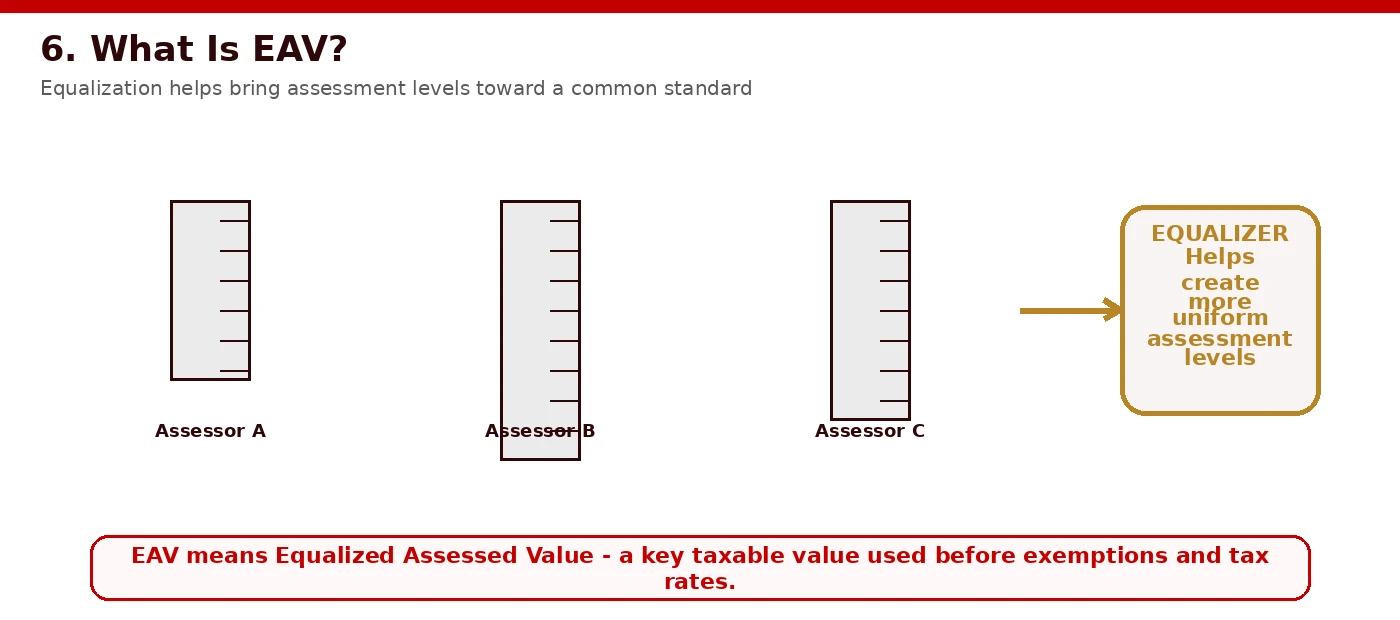
EAV is the foundational taxable figure in the Illinois property tax calculation.
Because assessment standards can vary across local township assessors, the Illinois Department of Revenue conducts annual sales-ratio studies to compare assessed values against actual arm’s-length market sales prices over a three-year window.
IDOR then certifies an equalization factor for each county. Think of equalization as a state-level calibration tool: it adjusts the county’s aggregate assessments to ensure taxpayers across different counties pay their fair constitutional share into multi-county school, college, and transportation taxing bodies.
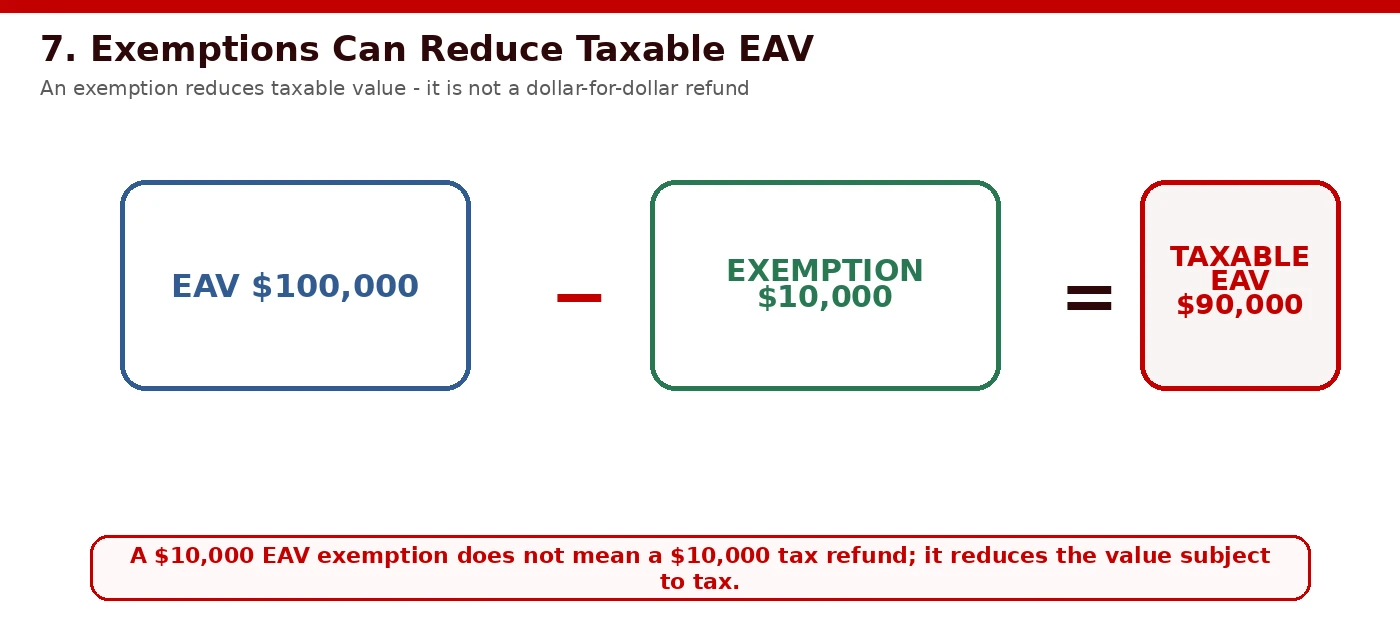
7. Illinois Property-Tax Exemptions Can Reduce Taxable EAV
Tax ReliefAn exemption reduces taxable valuation—not the final tax bill dollar-for-dollar.
Homeowners in Illinois may be eligible for statutory property tax exemptions that reduce their tax liability. The most common residential relief programs include:
General Homestead / Homeowner Exemption
Available to residential properties occupied as the principal residence by the owner. In Cook County, this exemption reduces EAV by up to $10,000; in most collar counties, it reduces EAV by up to $6,000 or as prescribed by statute.
Senior Citizens Homestead Exemption
Available to qualifying homeowners aged 65 or older who occupy the home. Provides an additional reduction in EAV (up to $8,000 in Cook County; $5,000 in collar counties).
Senior Citizens Assessment Freeze Homestead Exemption
For qualifying seniors with total household incomes below statutory thresholds (currently $65,000), freezing the taxable EAV at the base year level.
Veterans & Persons with Disabilities Exemptions
Substantial EAV reductions or complete exemptions for qualifying disabled veterans and persons with documented disabilities.
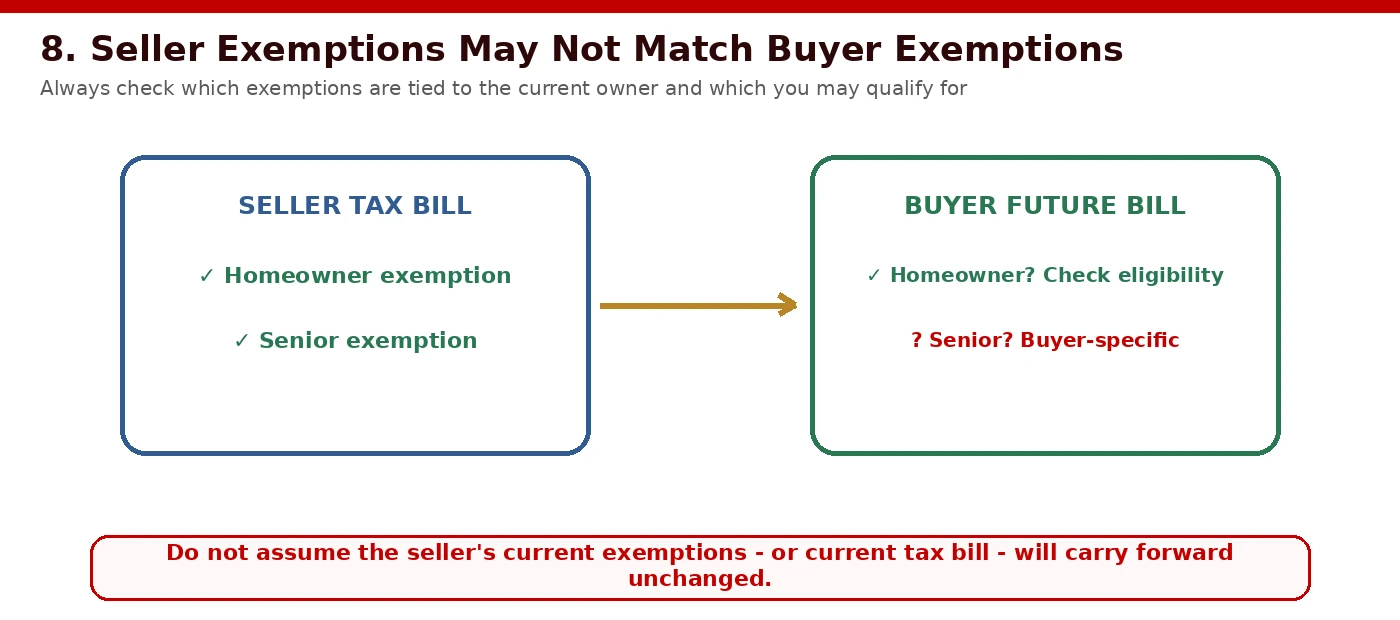
8. Check the Seller’s Exemptions Before You Buy
The seller’s current property-tax bill may include benefits you will not receive.
This is one of the most frequent post-closing shocks for first-time buyers in the Chicago suburbs.
If the current seller is 75 years old and has lived in the home for thirty years, their current tax bill may be suppressed by the Homeowner Exemption, the Senior Citizens Homestead Exemption, and the Senior Assessment Freeze. If you are a 32-year-old buyer, you will only qualify for the standard Homeowner Exemption once you meet residency requirements.
When the seller’s senior freeze and senior exemptions drop off in the subsequent tax billing cycle, your property-tax bill could jump by $2,000, $3,500, or more per year. Always audit the line-item exemptions on the seller’s current tax bill before drafting your offer budget (see our First-Time Homebuyer Checklist for Illinois).
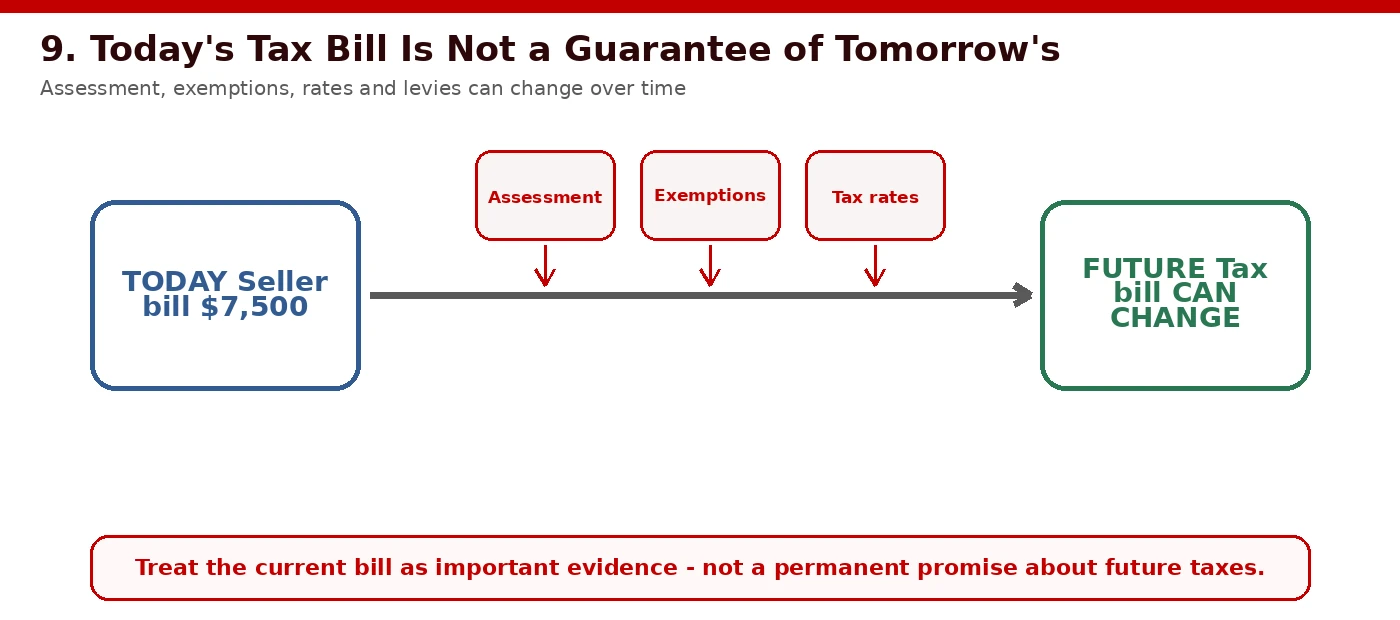
9. The Seller’s Current Tax Bill Is Not a Guarantee of Your Future Tax Bill
A useful historical number today can still change tomorrow.
In Illinois, property taxes are billed in arrears. That means the tax bill you pay in 2026 actually pays for the 2025 assessment tax year.
Because there is a multi-month lag between valuation and final billing, an historical tax bill reflects past assessments, past exemption statuses, and past municipal levy budgets. Treat the current tax bill as valuable baseline evidence—but never treat it as an immutable multi-year guarantee.
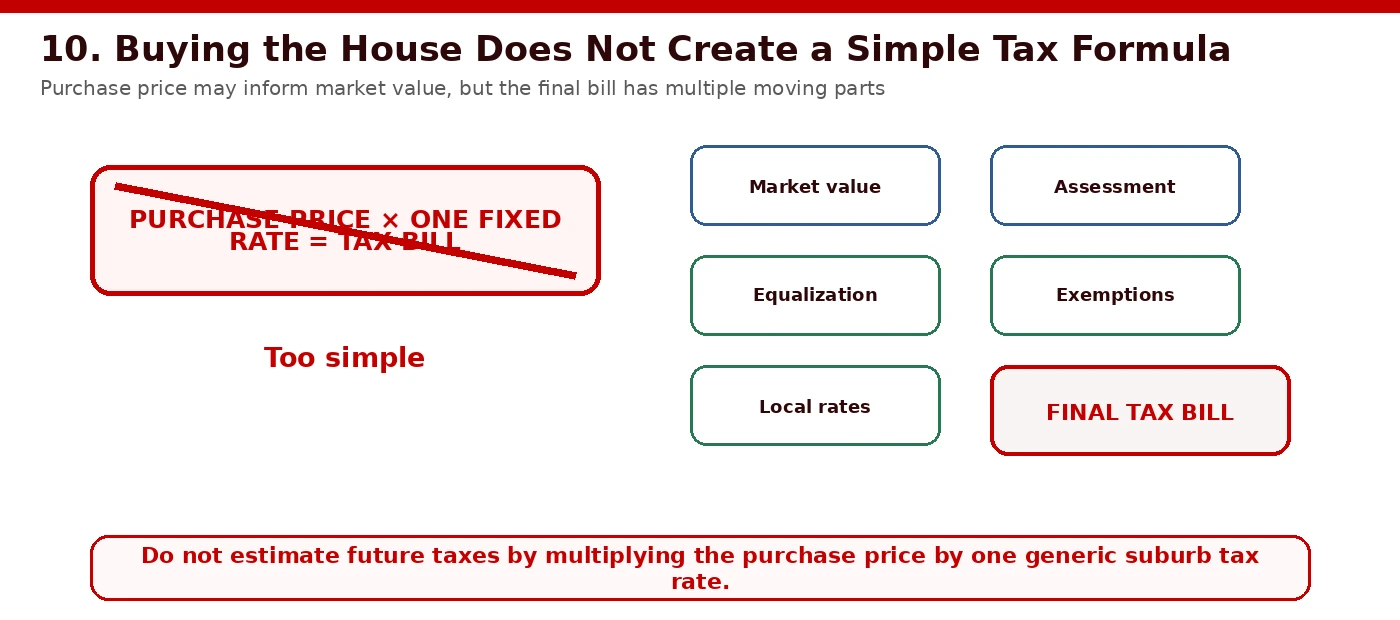
10. Does Buying a Home Automatically Reset Taxes to the Purchase Price?
Do NOT estimate future taxes using: purchase price × one generic suburb rate.
In Illinois, purchasing a home does NOT trigger an automatic, immediate statutory reassessment to your purchase price the next morning. Assessors use mass-appraisal computer models that evaluate recent sales of similar homes across your entire neighborhood triad or township during scheduled assessment cycles.
While your recorded purchase deed becomes public market evidence that the assessor will review during the next reassessment cycle, estimating future taxes by multiplying your contract price by a single back-of-the-napkin percentage found online is misleading and inaccurate.
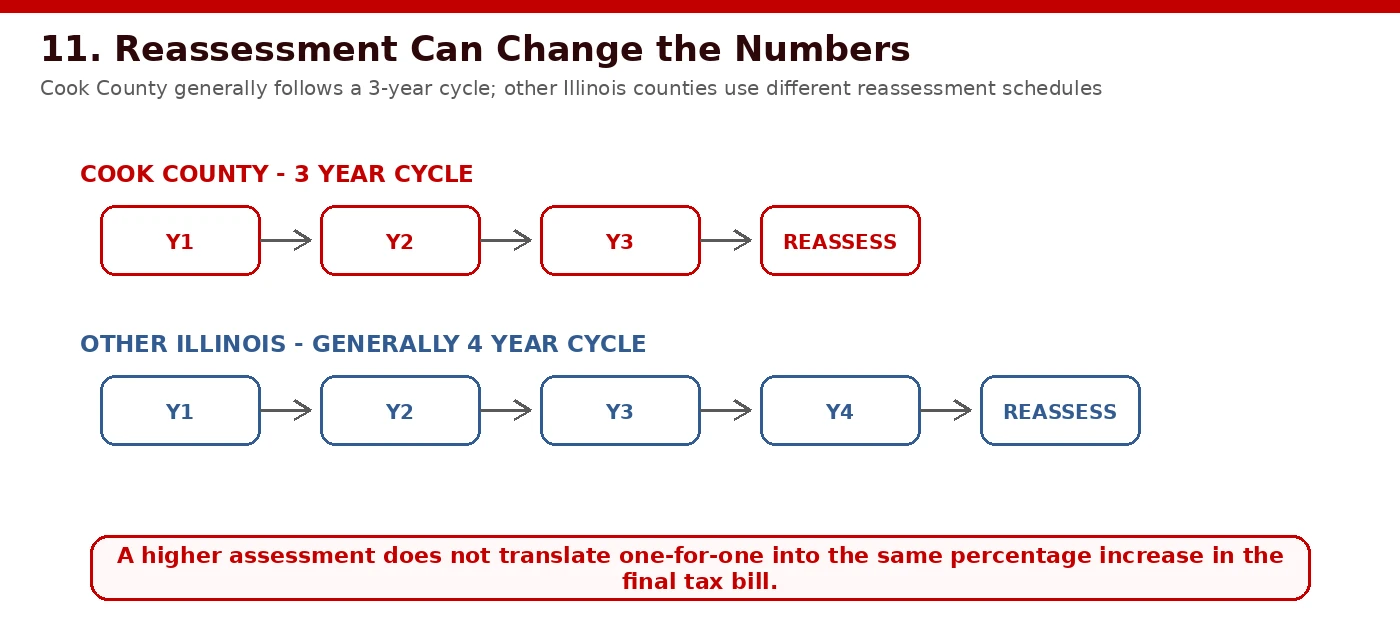
11. Reassessment Can Change the Numbers
Triennial / QuadrennialKnow when a property is reassessed and how the calendar affects your cash flow.
Every property in Illinois is periodically reassessed on a statutory cycle:
- Cook County: Reassessed once every three years (triennial cycle), rotating sequentially among the City of Chicago, the North/Northwest Suburbs, and the South/Southwest Suburbs.
- Collar Counties (Lake, DuPage, Will, Kane, McHenry): Reassessed on a statutory four-year general assessment cycle (quadrennial), with annual revisions by township assessors for market changes and physical updates.
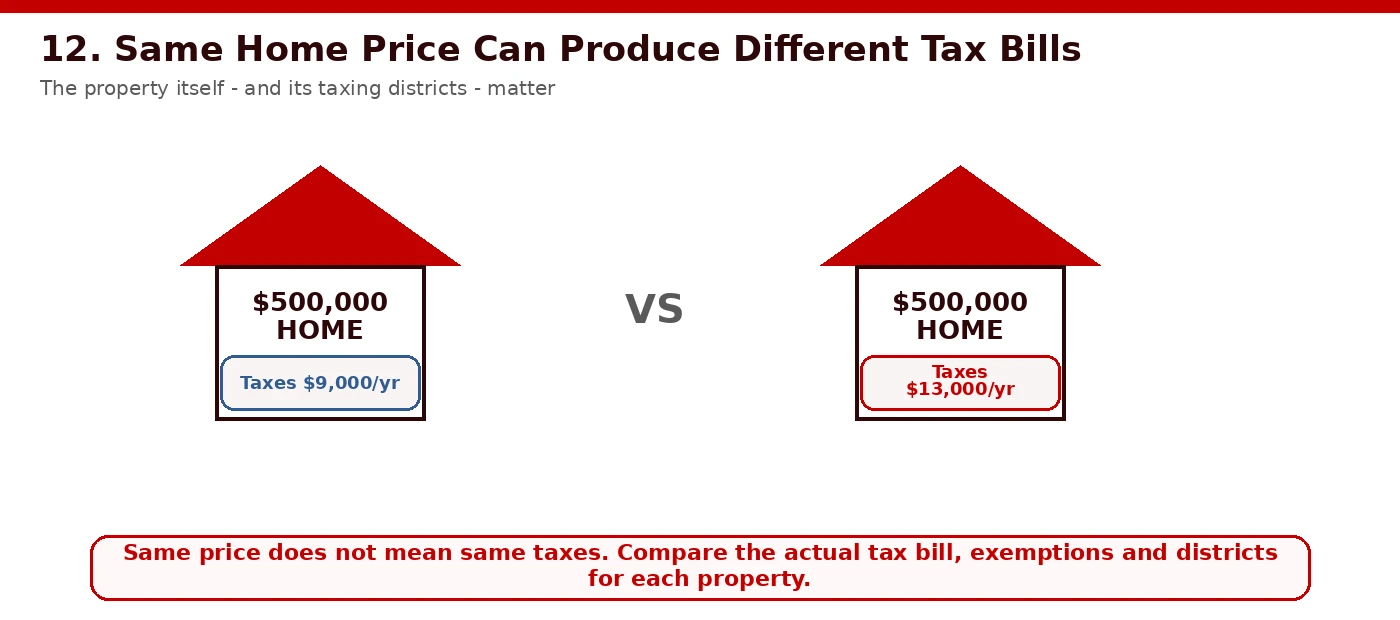
12. Why Can Two $500,000 Homes Have Different Property Taxes?
Same price. Different parcel. Completely different tax result.
As highlighted in our regional buyer guide to the Best Northwest Chicago Suburbs for Families, buyers touring homes across Schaumburg, Palatine, Arlington Heights, Mount Prospect, and Buffalo Grove often find $500,000 homes whose tax bills vary by thousands of dollars.
The discrepancy usually stems from five core structural differences:
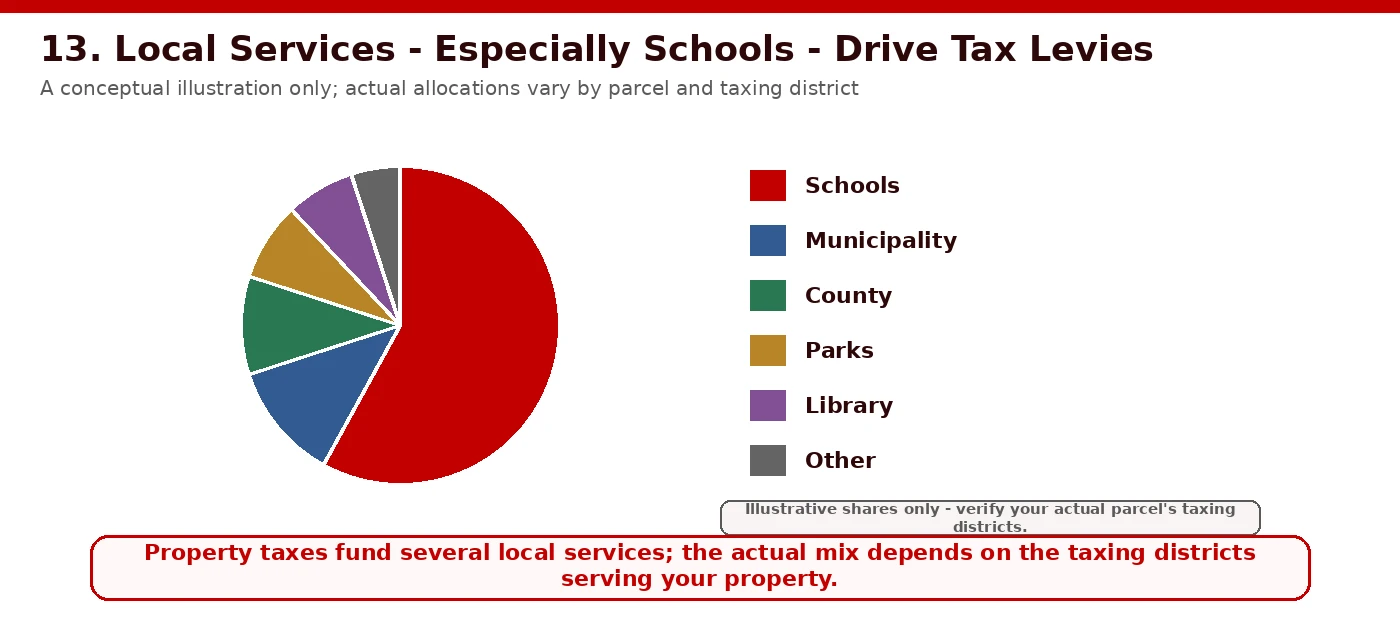
13. School Districts Are a Major Part of the Property-Tax Picture
Local tax levies support schools and other vital public infrastructure.
According to data published by the Illinois Department of Revenue, public elementary, secondary, and unit school districts consistently receive the single largest portion of real estate tax dollars in Illinois—frequently accounting for 60% to 70%+ of the total tax bill.
When homeowners discuss high property taxes in Chicagoland, they are largely funding local education, teacher pensions, athletic facilities, and school district operations. Because school funding in Illinois is heavily reliant on local property taxes rather than state income taxes, areas with well-resourced school systems typically require higher local property tax levies.
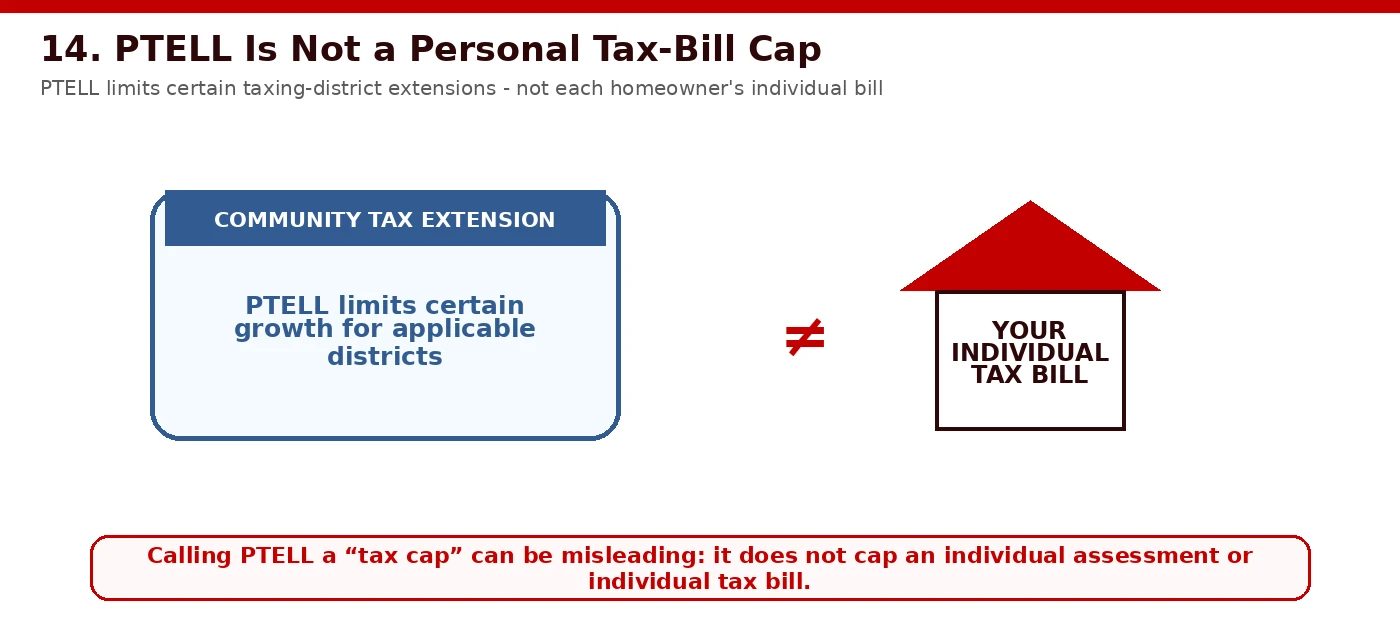
14. What Is PTELL—and Why “Tax Cap” Can Be Misleading
State StatutePTELL limits aggregate taxing-district levies—not individual homeowner tax bills.
The Property Tax Extension Limitation Law (PTELL), enacted under 35 ILCS 200/18-185, applies to non-home-rule taxing districts across Cook County and the collar counties.
Many people refer to PTELL as a “tax cap law,” which creates a dangerous misconception. PTELL does not place a cap on how much an individual homeowner’s assessment or tax bill can rise.
Instead, PTELL restricts the annual growth in the aggregate total property tax dollars that a taxing district can collect from the entire community. That growth is limited to the lesser of 5% or the national Consumer Price Index (CPI-U) from the preceding year, plus allowances for new construction and voter-approved referenda.
15. How Are Property Taxes Paid?
Escrow and direct-payment buyers need different cash-flow plans.
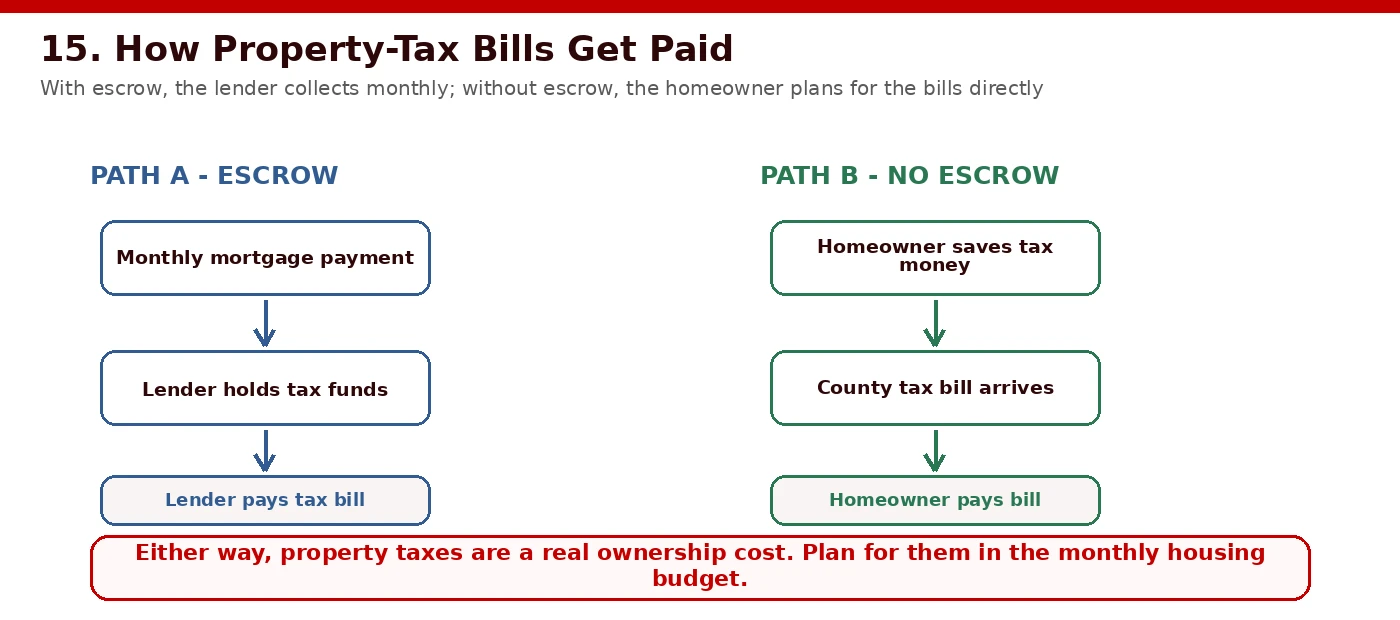
When you own a home, your property taxes are paid in one of two ways:
Path A: Mortgage Escrow
Required by most lenders when putting down less than 20%. Each month, your mortgage servicer collects 1/12th of your estimated annual property taxes along with principal and interest. The servicer holds these funds in an escrow account and disburses payment directly to the county treasurer when bills come due.
Path B: Direct Payment
Available to buyers who put down 20%+ or pay cash and opt out of escrow. You are directly responsible for saving funds throughout the year and submitting payment installments to your county treasurer by the official due dates via online portal, mail, or in person.
16. Convert Annual Property Taxes Into a Monthly Cost
This is the simplest, most effective way to evaluate real-world affordability.
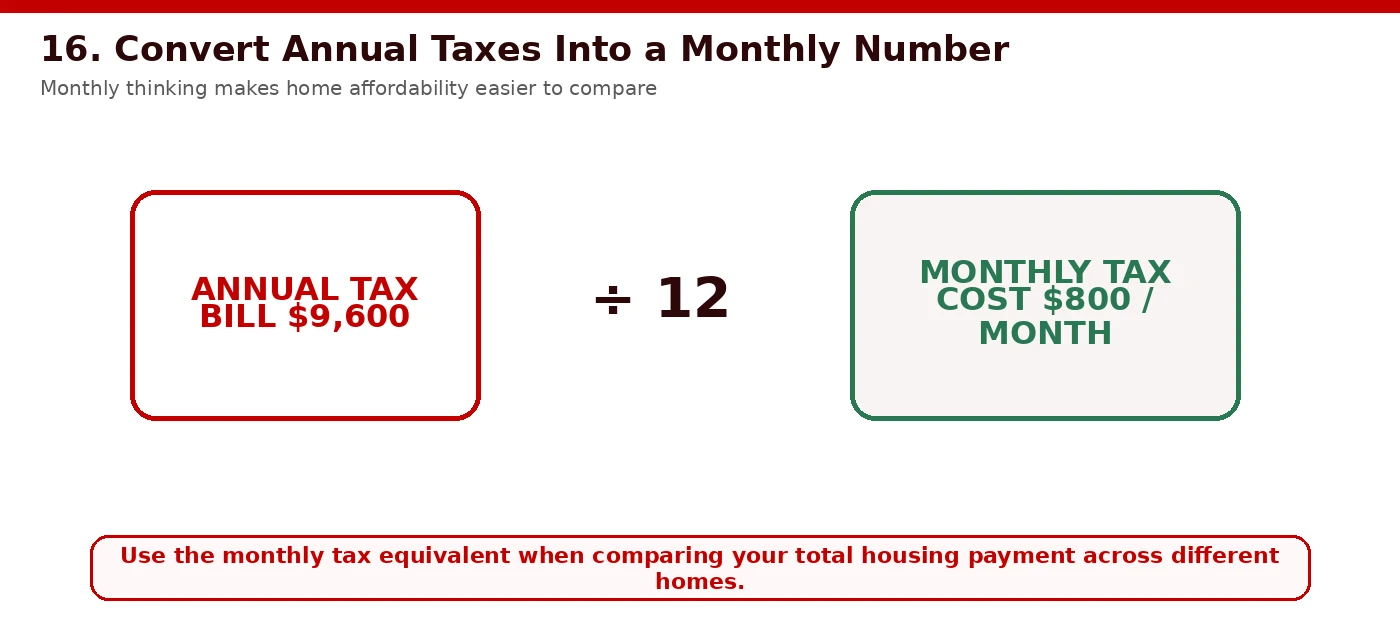
When shopping for homes, list prices are easy to focus on, while annual tax numbers ($9,600 or $12,400) feel abstract. The most practical technique is to convert the annual tax bill into its monthly equivalent before touring:
For an illustrative example: an annual property tax bill of $9,600 equals approximately $800 per month. A home with $12,000 in taxes costs $1,000 per month. (To see how this fits into your overall monthly mortgage and debt-to-income limits, explore our deep dive: How Much House Can You Afford in the Chicago Suburbs?).
17. Check Property-Tax Exemptions Before Buying
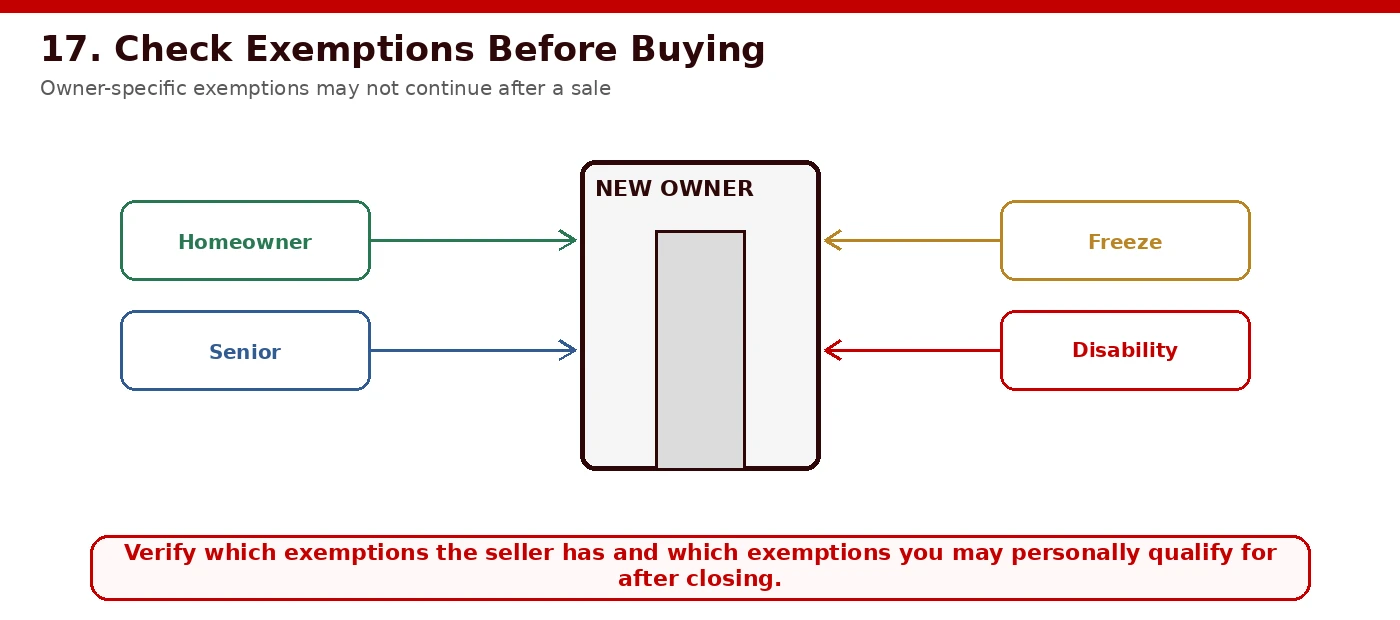
Not every exemption on the seller’s bill transfers to the next owner.
Before finalizing your budget or submitting an offer, perform a thorough exemption audit on the property’s tax portal:
18. Improvements Can Affect Property Taxes
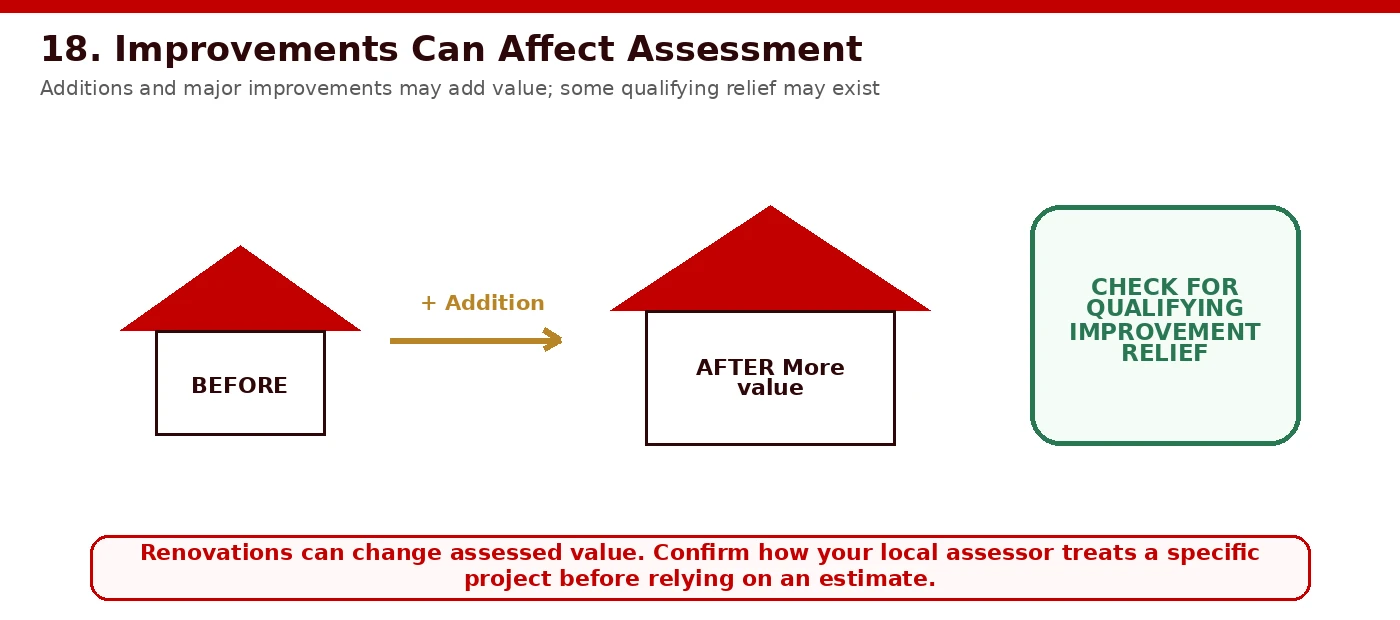
A major remodel or addition can change assessed valuation.
According to IDOR guidance, major capital improvements—such as room additions, finishing an unfinished basement, expanding a garage, or building a permanent deck or in-ground pool—frequently trigger assessment increases when building permits are filed.
However, routine maintenance like replacing an existing asphalt shingle roof, painting, or updating interior kitchen cabinets generally does not trigger an immediate reassessment. Furthermore, programs like the Illinois Home Improvement Exemption allow qualifying homeowners to defer assessment increases on up to $75,000 of newly added value for up to four years. Always consult the local assessor before undertaking large renovations.
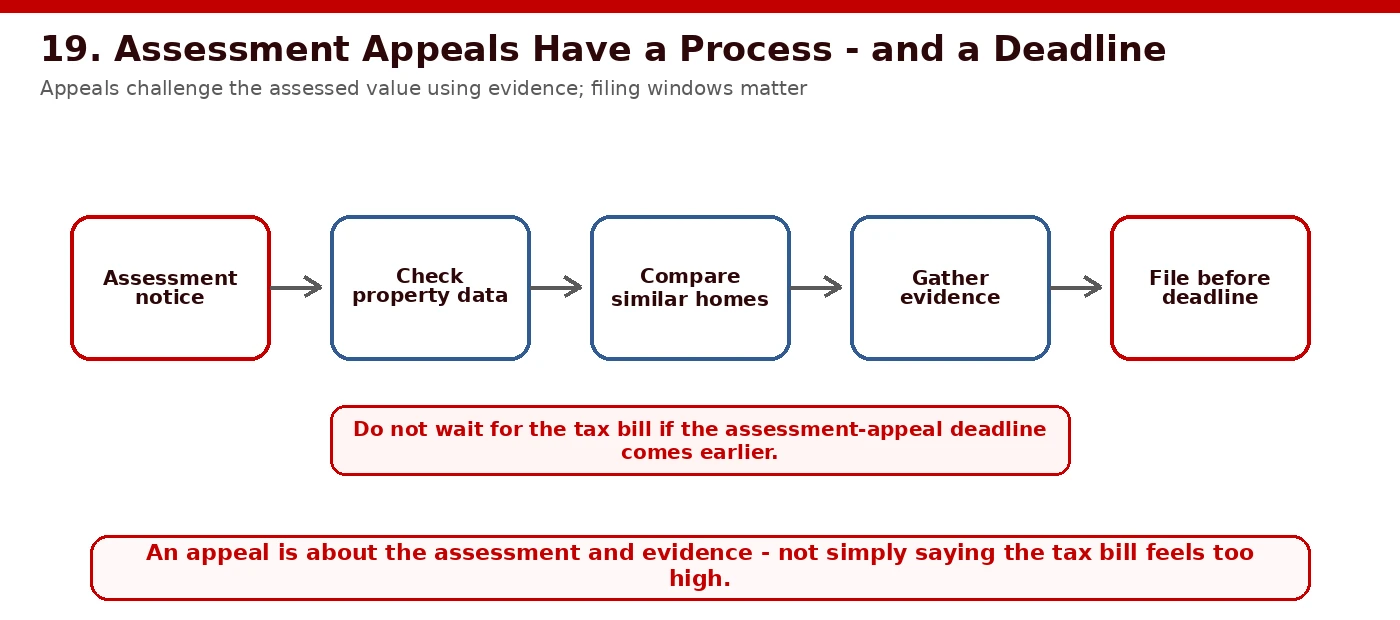
19. Can You Appeal Property Taxes?
Due ProcessAn appeal challenges the assessed valuation—and strict filing deadlines apply.
In Illinois, homeowners have a statutory right to appeal their property assessment. However, you cannot simply appeal on the grounds that your property-tax bill feels too expensive. An appeal is strictly an evidence-based challenge against the county assessor’s valuation.
Legitimate grounds for an assessment appeal generally fall into three categories:
1. Incorrect Property Characteristics
The assessor’s property card lists an incorrect square footage, lists four bathrooms when you have two, or records a finished basement that is actually unfinished.
2. Overvaluation Compared to Market Value
Recent arm’s-length sales of nearly identical neighboring homes prove the assessor’s market valuation is higher than real market value.
3. Lack of Uniformity
Similar properties within your immediate subdivision or neighborhood code are assessed at a significantly lower value per square foot.
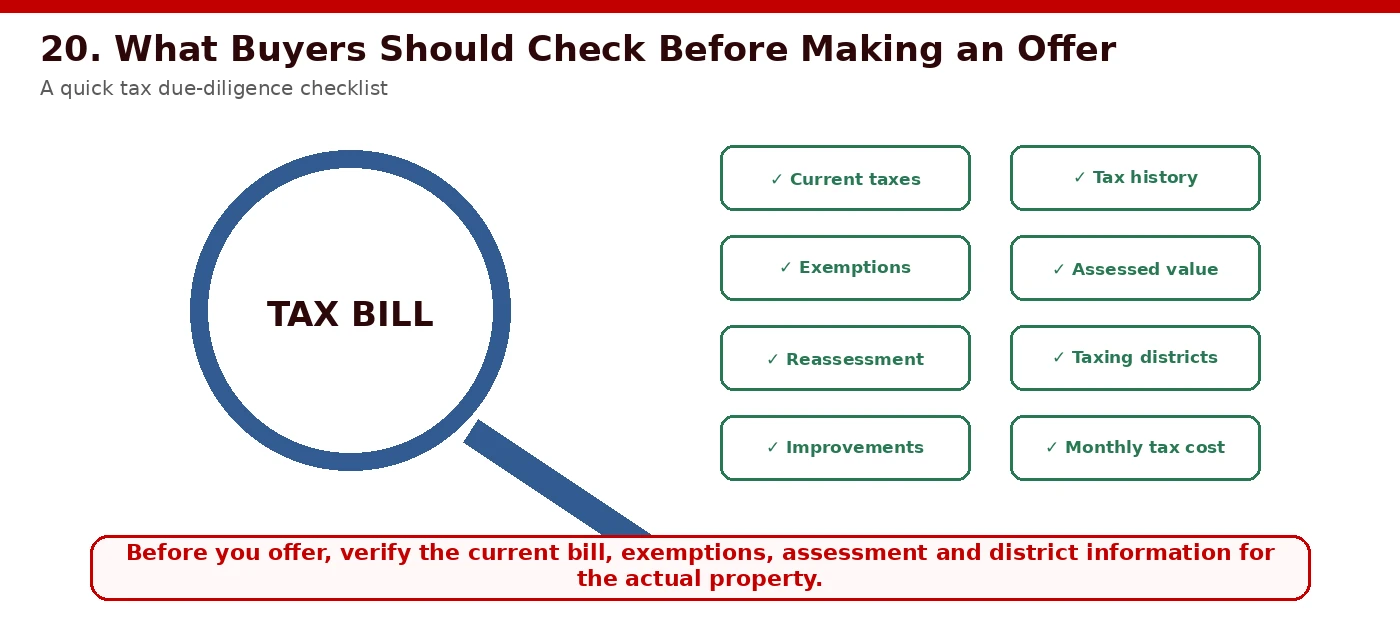
20. What Should Buyers Check Before Making an Offer?
A practical Chicago suburbs property tax due-diligence list.
Before signing an Illinois residential purchase contract, obtain the property’s official 14-digit Property Index Number (PIN) and check these seven data points:
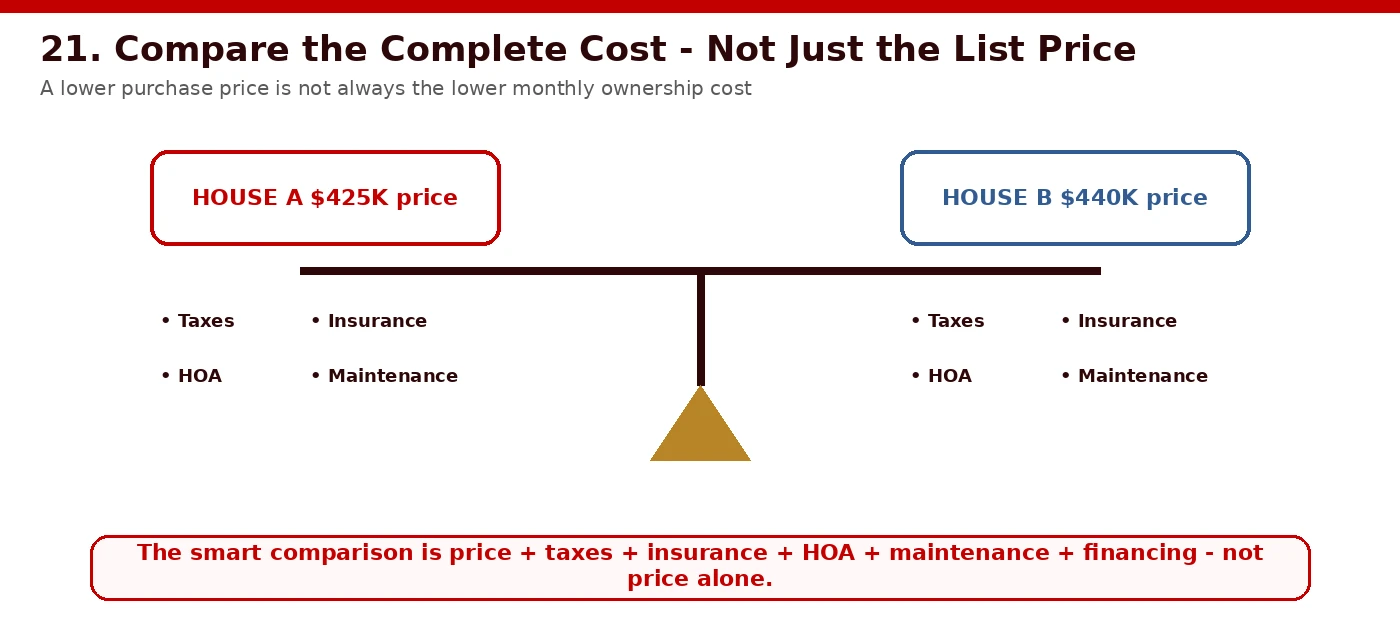
21. Compare the Complete Cost—Not Just the Listing Price
Property taxes can change which home is truly more affordable.
When budgeting, the purchase price represents only one component of your monthly financial obligation. Your true monthly carrying cost combines:
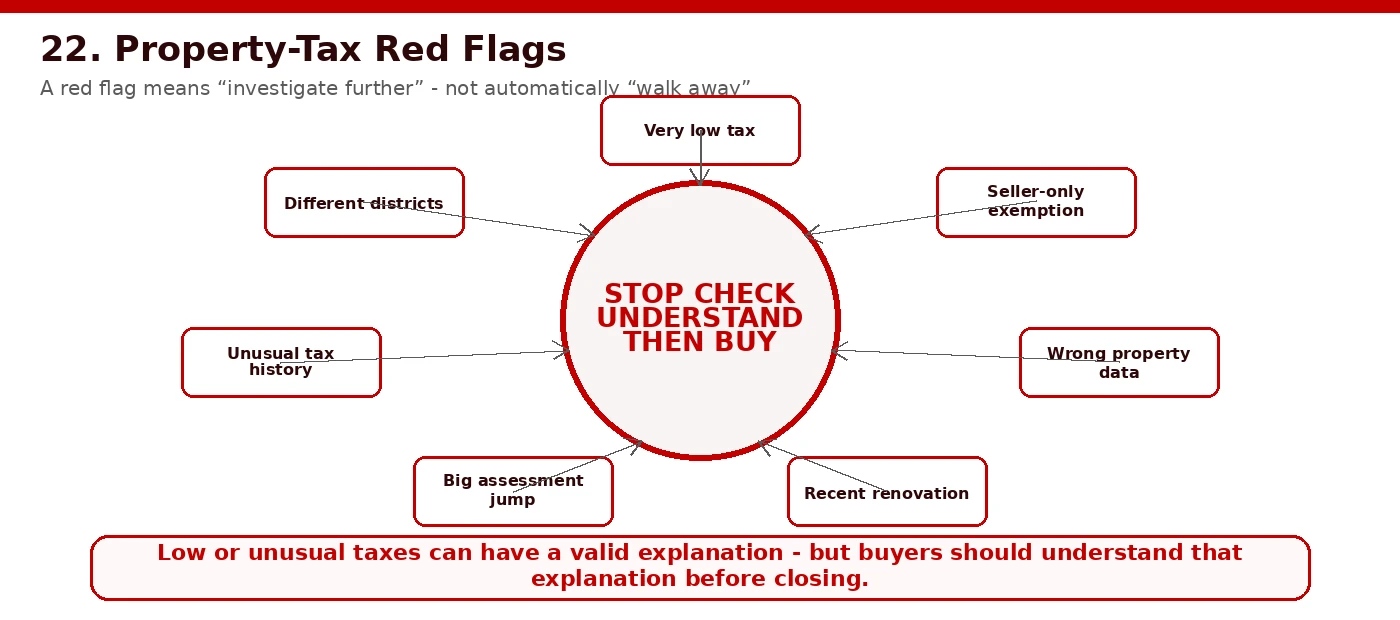
22. Property-Tax Red Flags for Chicago Suburban Buyers
A red flag means “ask more questions”—not automatically “do not buy.”
When inspecting property records, watch for these common discrepancies:
1. Dramatically Lower Tax Bill Than Neighboring Identical Homes
Often indicates the seller receives an unfreeze exemption, senior exemption, or disability relief that will disappear post-closing.
2. Record Shows Mismatched Characteristics
Listing says 2,800 sq ft, but the assessor card says 1,900 sq ft. An unpermitted addition may be caught during the next reassessment.
3. Recent Unexplained Spikes or Drops in Historical Taxes
Could indicate a recent successful appeal, an expiration of a temporary incentive, or a special municipal referendum bond issue.
4. High Special Assessments or Local Taxing District Debt
A school district with substantial recent construction debt referenda may experience rising tax rates over the coming decade.
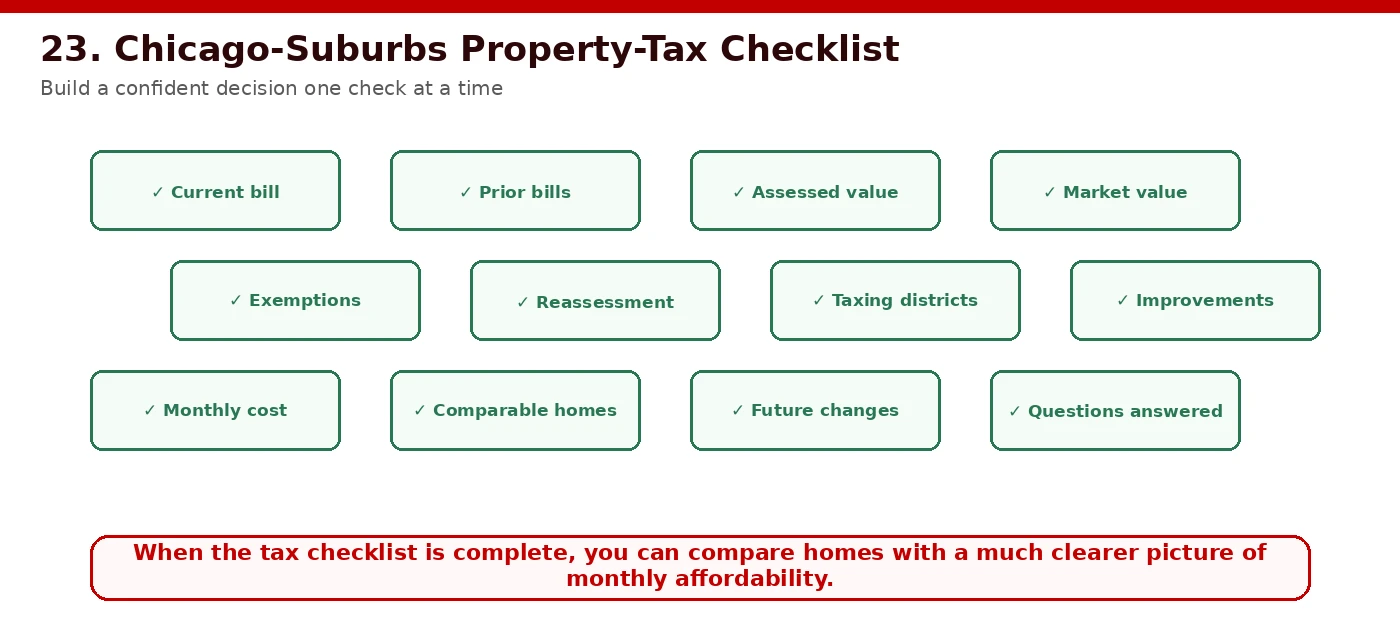
23. Chicago Suburbs Property-Tax Checklist
Complete these 10 diligence steps before submitting an offer on any Chicagoland property.
24. Final Example: Why Property Taxes Can Change the Decision
A $20,000 price difference can be far smaller than a recurring tax difference.
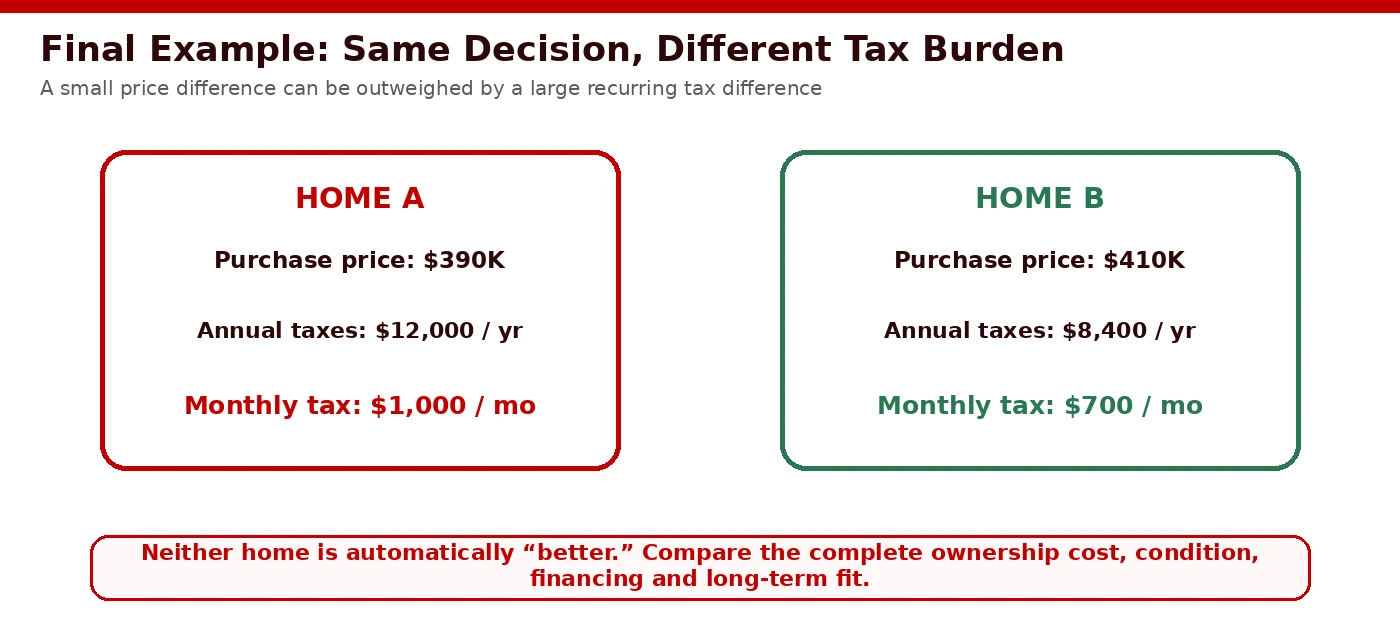
To see how this works in real life, consider a simple educational comparison between two hypothetical homes:
Hypothetical Comparison: Home A ($390k) vs. Home B ($410k)
Hypothetical IllustrationNotice: This hypothetical example uses rounded figures to illustrate the ongoing impact of property taxes on monthly cash flow. It does not reflect specific live quotes or specific properties.
Home A: Lower Purchase Price
$390,000 List Price
- Annual Property Taxes: $12,000/yr
- Monthly Tax Equivalent: $1,000/mo
- Estimated P&I (illustrative): $2,050/mo
- Combined P&I + Taxes: ~$3,050/mo
Home B: Higher Purchase Price
$410,000 List Price
- Annual Property Taxes: $8,400/yr
- Monthly Tax Equivalent: $700/mo
- Estimated P&I (illustrative): $2,150/mo
- Combined P&I + Taxes: ~$2,850/mo
The Takeaway: Home B has a \$20,000 higher listing price, yet saves approximately \$200 per month in combined carrying costs—amounting to \$2,400 in annual savings. Never evaluate affordability from the purchase price alone.
25. Official Sources & Fact Verification
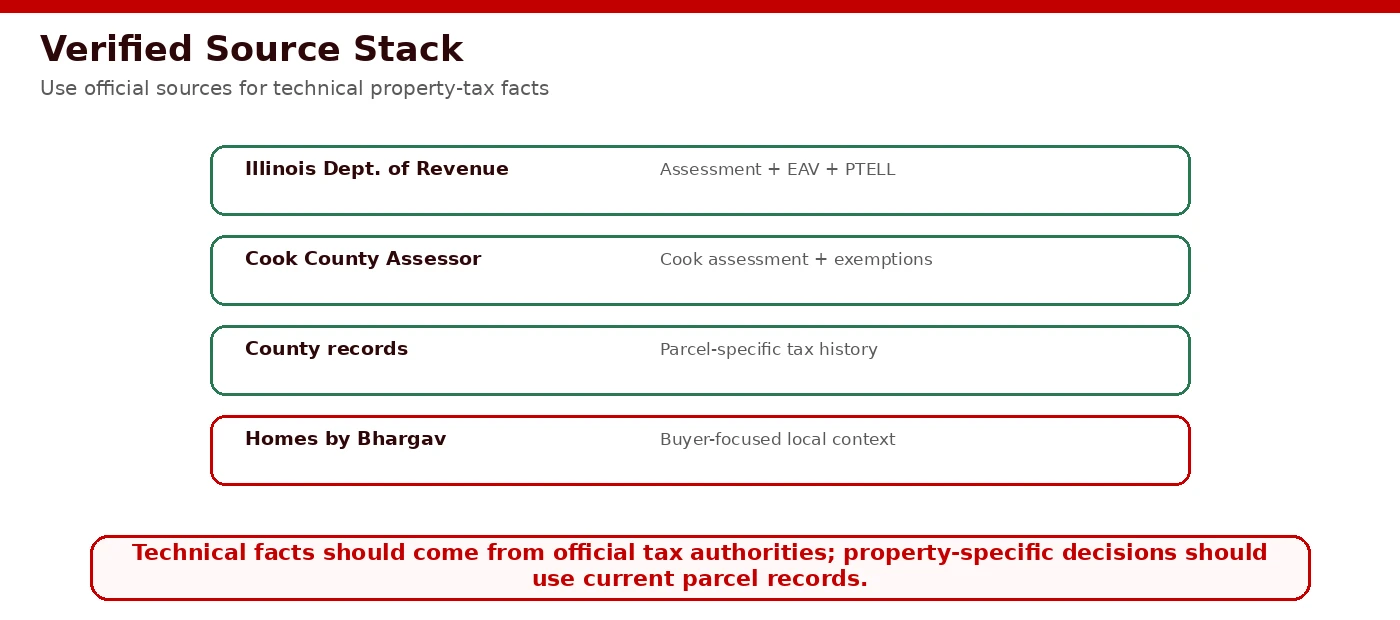
Verified GuidanceAuthoritative public resources for verifying parcel-specific tax information.
The technical rules and statutory concepts explained in this guide are cross-referenced directly with current official Illinois and county tax publications:
Educational & Legal Notice
This guide is prepared for general educational and consumer research purposes only. Property tax laws, assessment methods, exemption amounts, equalization multipliers, local tax levies, and appeal filing deadlines change periodically and differ across counties and individual parcels. Neither Homes by Bhargav nor its agents provide legal, accounting, tax, or appraisal advice. Buyers and homeowners should verify current property-specific tax information with their designated county assessor, county treasurer, school district, real estate attorney, or certified tax professional.
Understanding the Taxes Before You Make an Offer
Homes by Bhargav helps homebuyers compare properties across Chicagoland using the complete ownership picture: purchase price, property tax history, property condition, HOA dues, comparable properties, and monthly affordability.
Whether you are evaluating homes in Schaumburg, Palatine, Arlington Heights, Mount Prospect, Hoffman Estates, Des Plaines, or surrounding communities, we help you uncover the parcel-level details that shape your real financial future.
Bhargav Shah, REALTOR®
Licensed Real Estate Professional • Homes by Bhargav
Phone: (510) 203-9270 • Website: HomesByBhargav.com