


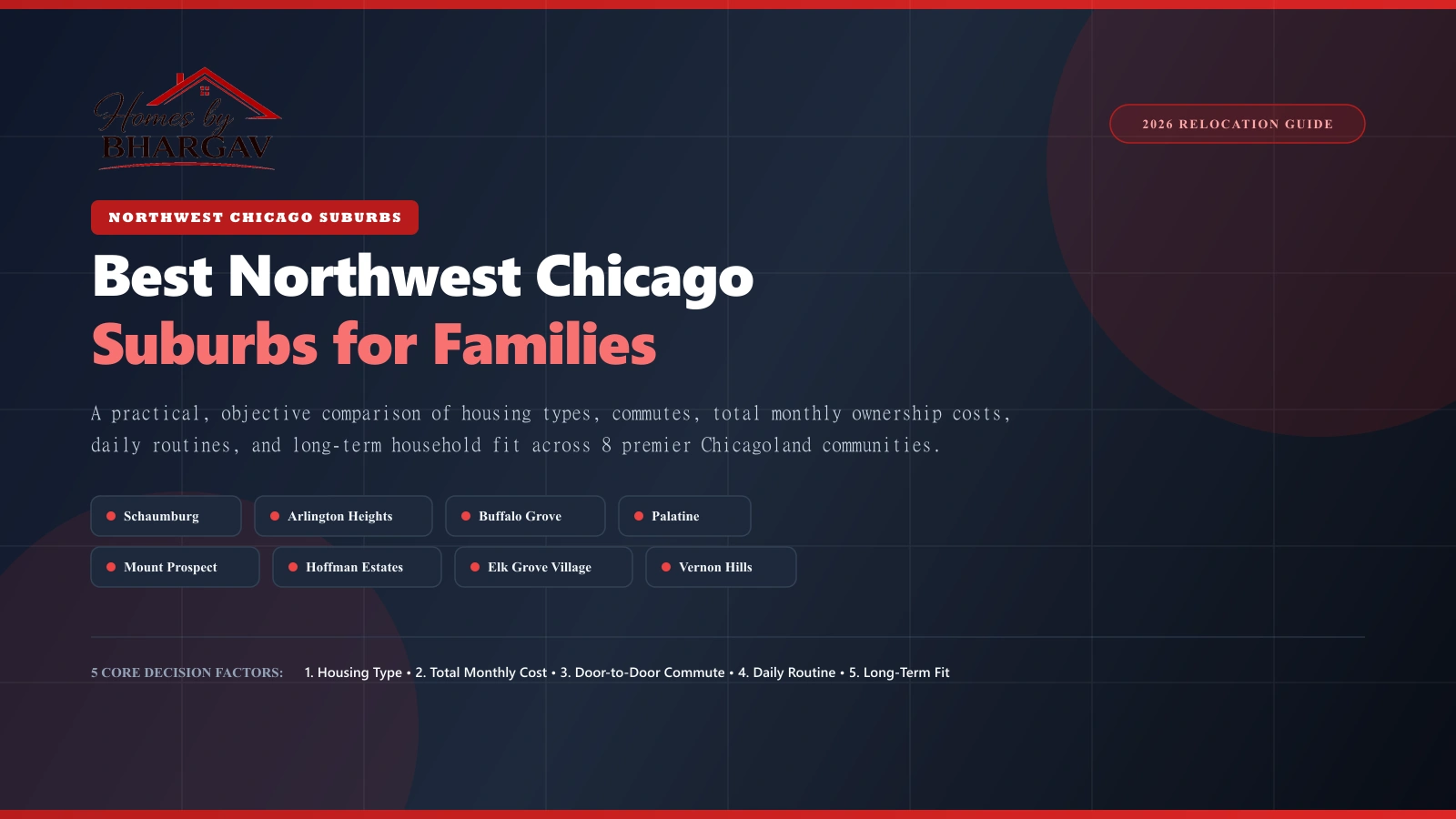
Best Northwest Chicago Suburbs for Families: 2026 Homebuyer & Relocation Guide
An Objective, Practical Comparison of Schaumburg, Arlington Heights, Buffalo Grove, Palatine, Mount Prospect, Hoffman Estates, Elk Grove Village & Vernon Hills
Fair Housing & Relocation Transparency
This guide provides educational comparison based strictly on objective, neutral criteria: housing inventory, transportation infrastructure, property taxes, daily routine logistics, and monthly ownership math. It does not rank communities by protected characteristics or steer buyers toward or away from neighborhoods.
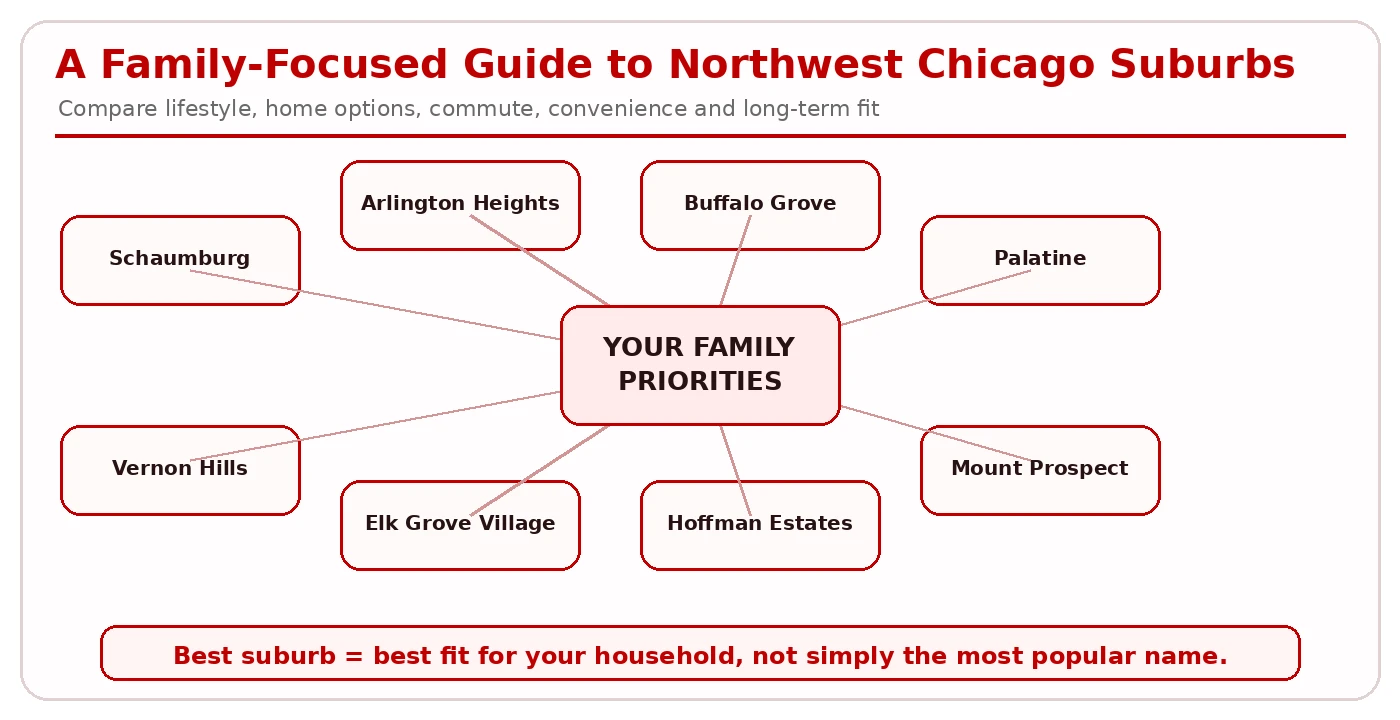
Choosing among the best northwest Chicago suburbs for families is not about finding one universal winner. A community that works beautifully for one household may not fit another household’s budget, commute, housing preferences, or daily routine.
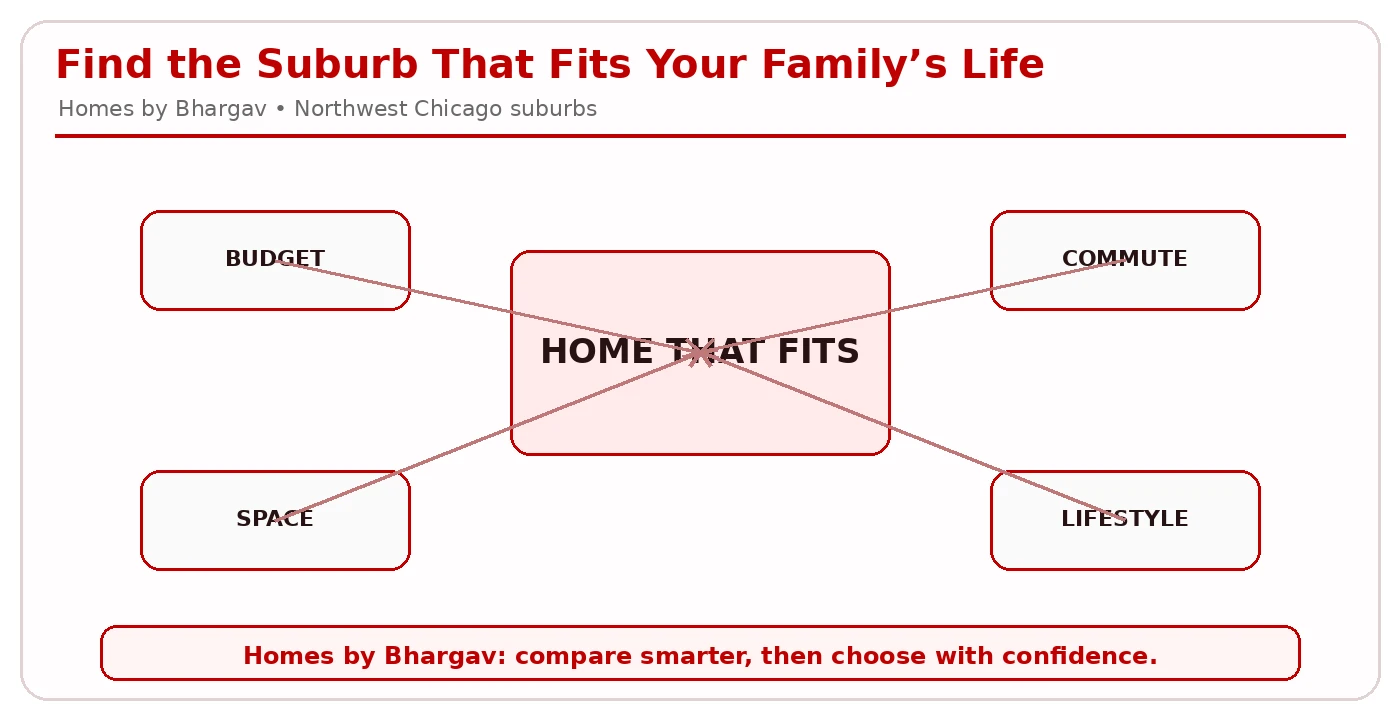
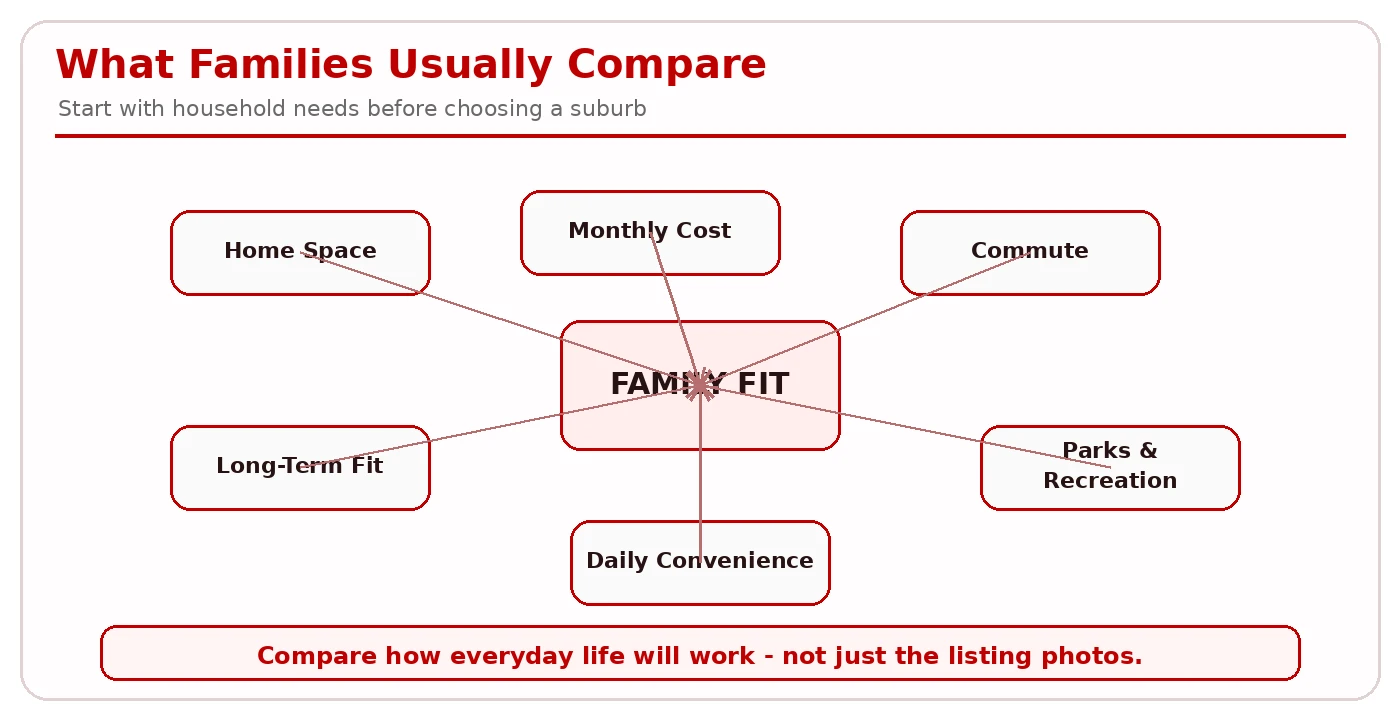
Before focusing on a suburb name, define the life you want the home to support. Compare the amount of space you need, your comfortable monthly cost, how far you are willing to travel, access to parks and everyday services, and whether the home can still work as your needs change over time.
Core Relocation Principle
“The best suburb is the one that makes your family’s real life work well.”
A town with great prestige is the wrong town if the mortgage strains your finances, the commute steals hours from your evenings, or the housing stock doesn’t suit your family’s living style.
8Northwest Chicago Suburbs at a Glance
Eight premier communities across northern Cook County and southern Lake County, each offering unique strengths:
Convenience, housing variety, retail hubs & Busse Woods access.
Connected downtown, vibrant dining & direct Metra UP-NW rail.
Quiet residential character, green spaces & Lake/Cook access.
Housing flexibility, diverse price points & Metra UP-NW access.
Predictable weekday routine, established charm & Metra rail.
Space/value balance, forest preserves & regional road access.
Strategic expressway access (I-90, I-290, I-390) & quiet neighborhoods.
Northern suburban corridor, retail convenience & park districts.
What Makes a Northwest Chicago Suburb a Good Fit for a Family?
Start with your household’s real routine, budget, and home needs.
When families begin searching for homes in the northwest suburbs, they often start with town names they have heard from friends or coworkers. But a suburb’s broad reputation rarely tells you whether an individual block, property, or daily commute will actually work for your household.
Instead of asking which town is “the best,” evaluate how each location aligns with your five non-negotiable household pillars:
Home Size & Property Type
Single-family lot, two-story layout, low-maintenance townhome, or single-level condo.
Total Monthly Ownership Cost
Mortgage P&I plus local Cook or Lake County property taxes, insurance, HOA dues, and maintenance.
Commute & Transportation
Metra commuter rail stations (UP-NW, MD-W, NCS) and regional expressways (I-90, I-290, Route 53).
Parks & Everyday Convenience
Proximity to grocery stores, pediatric clinics, community recreation centers, and forest preserves.
Long-Term Household Fit
Ability of the home and neighborhood to serve your changing needs over 3, 5, and 10 years.
1. Schaumburg
Central HubA practical comparison point for northwest Chicago homebuyers.
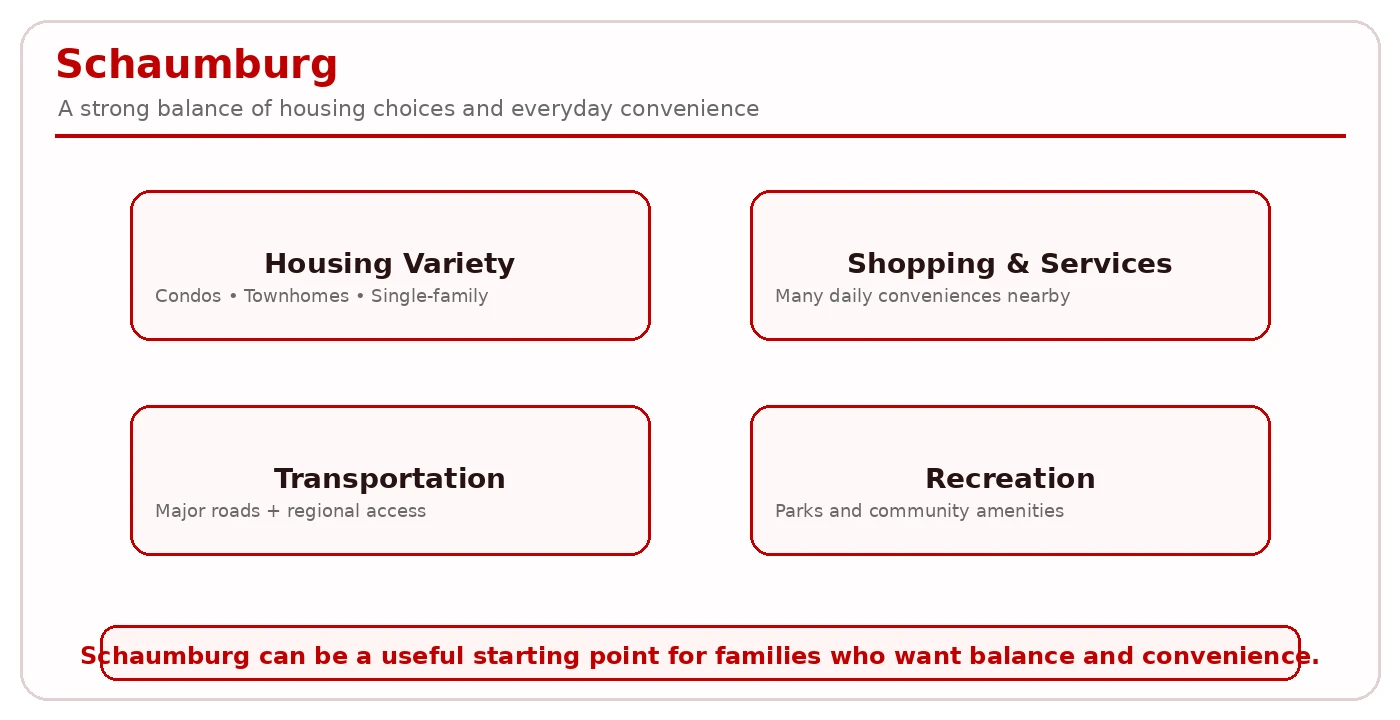
Schaumburg is one of the most versatile and practical starting points for buyers comparing the northwest Chicago suburbs. As an established suburban anchor, it offers a broad mix of housing choices: from low-maintenance entry-level condominiums and multi-level townhomes to spacious detached single-family homes across mature neighborhoods.
What sets Schaumburg apart is its remarkable concentration of everyday conveniences. Centered around the Woodfield retail corridor and surrounding business parks, residents enjoy rapid access to major grocery chains, healthcare centers, dining, and community entertainment without leaving town boundaries. If you are exploring this community, see our dedicated Schaumburg Real Estate Guide and our detailed buyer overview on Buying a Home in Schaumburg.
Housing Variety
Condos, attached townhomes, and detached single-family homes spanning multiple price tiers.
Shopping & Services
Extensive retail around Woodfield Mall, Streets of Woodfield, specialty markets, and medical centers.
Transportation
Interstate 90 (Jane Addams), I-290, Route 53, and the Schaumburg Metra station (Milwaukee District West line).
Parks & Recreation
Extensive Schaumburg Park District facilities, Olympic Park, Atcher Island, and direct access to Ned Brown Preserve (Busse Woods).
2. Arlington Heights
Downtown RailA practical comparison point for northwest Chicago homebuyers.
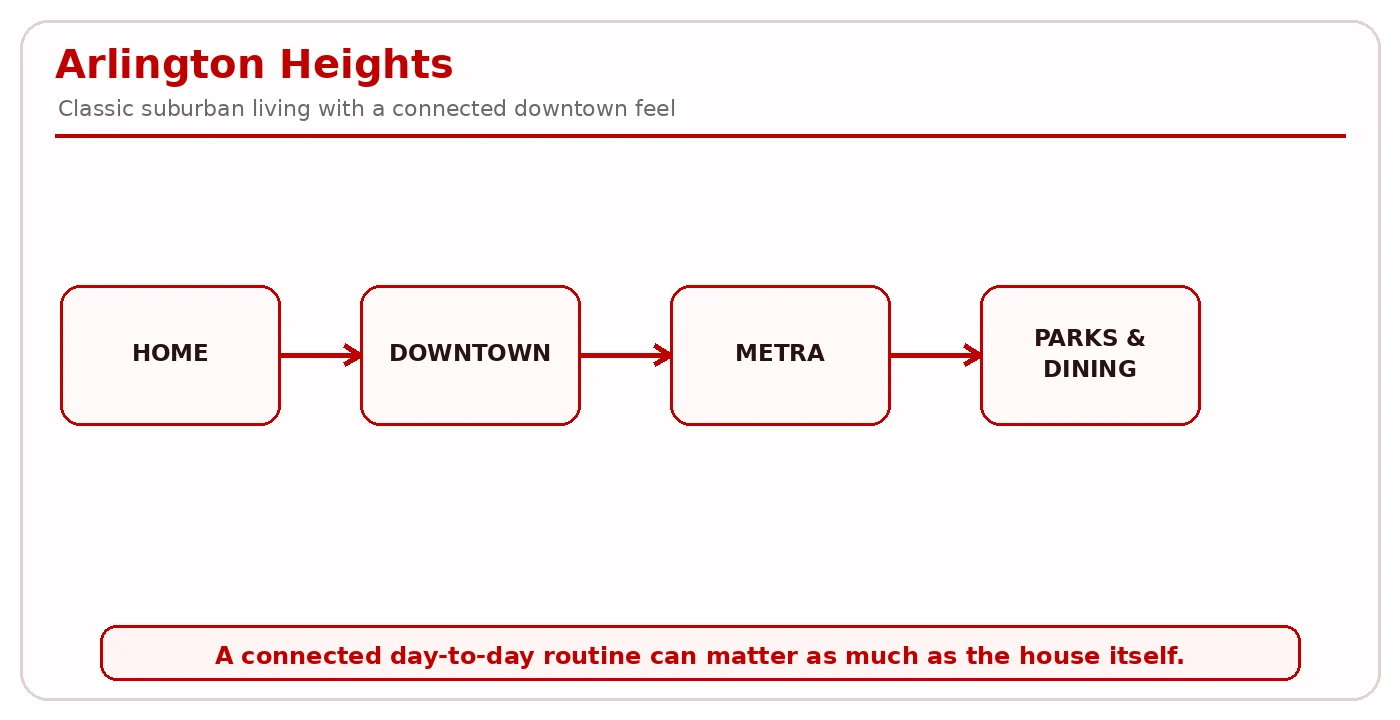
Arlington Heights is frequently sought by buyers who want a traditional suburban neighborhood feel coupled with an active, walkable downtown center. The vibrant downtown district around the Arlington Heights Metra station offers boutique shopping, local restaurants, coffee shops, and the Metropolis Performing Arts Centre, giving day-to-day life a connected community rhythm.
Housing stock ranges from historic homes and mid-century ranches to newer luxury infill and downtown transit-oriented condos. The key tradeoff is that home prices and property tax assessments can be noticeably higher than in neighboring villages. Buyers should compare the complete monthly cost and verify property condition rather than relying purely on the village’s established name.
Neighborhood Setting
Mature tree-lined streets, established residential subdivisions, and historic districts.
Downtown Environment
Pedestrian-friendly downtown with alfresco dining, independent cafes, and community festivals.
Commuter Rail Access
Direct express service into Chicago Ogilvie Transportation Center via the Union Pacific Northwest (UP-NW) line.
Housing Mix
Mix of charming older homes, expanded split-levels, modern infill construction, and transit-adjacent condominiums.
3. Buffalo Grove
Residential CalmA practical comparison point for northwest Chicago homebuyers.
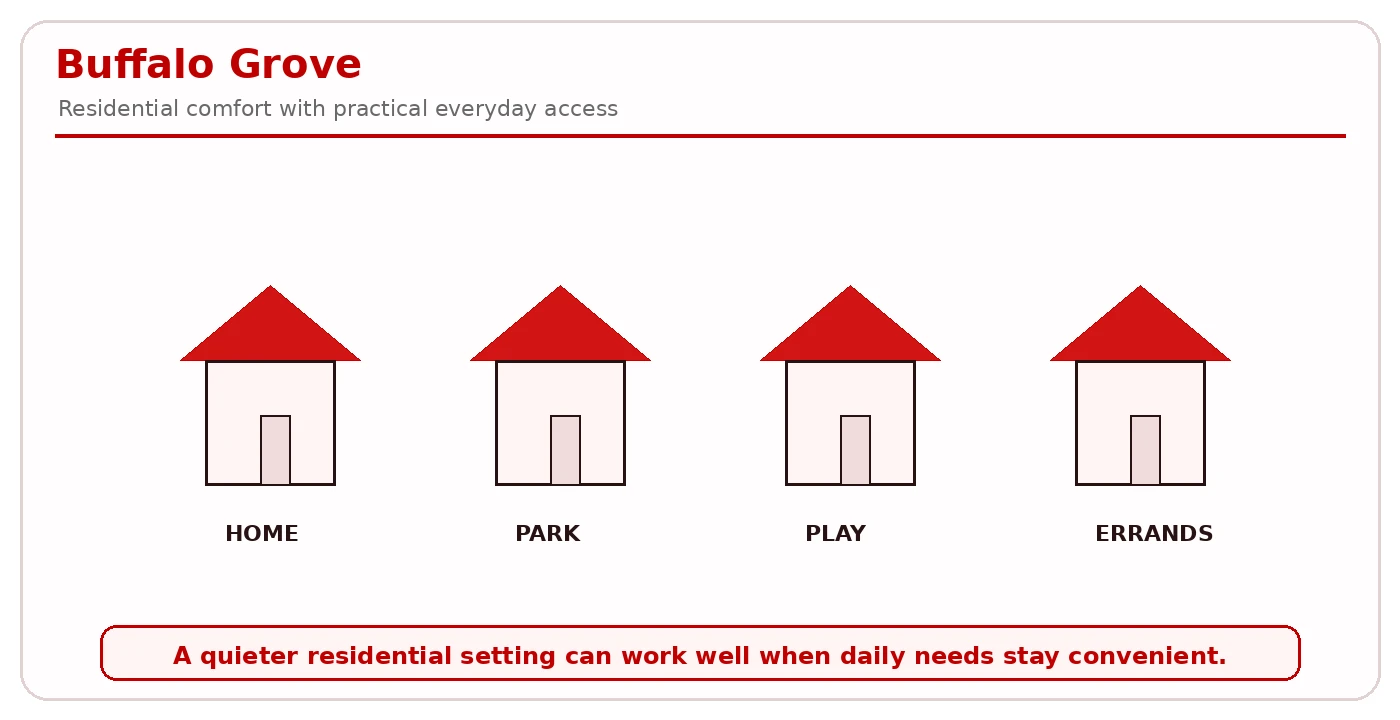
Buffalo Grove is a favorite comparison choice for households looking for a quiet, predominantly residential suburban atmosphere while maintaining seamless access to neighboring commercial corridors in Wheeling, Arlington Heights, and Lincolnshire.
Because Buffalo Grove spans both northern Cook County and southern Lake County, property tax rates, school districts, and municipal services can vary significantly based on which county the address falls in. Buyers must verify tax bills property-by-property. Housing includes well-maintained attached townhome communities and spacious single-family subdivisions with generous yard spaces.
Residential Character
Peaceful cul-de-sacs, low commercial cut-through traffic, and neighborhood pride of ownership.
Parks & Green Space
Willow Stream Park, Mike Rylko Community Park, golf courses, and an extensive municipal bike trail network.
Housing Choices
Established two-story colonials, ranches, split-levels, and planned attached-home communities.
County Considerations
Cook vs Lake County tax assessments and boundary lines require careful review during offer preparation.
4. Palatine
Housing FlexibilityA practical comparison point for northwest Chicago homebuyers.
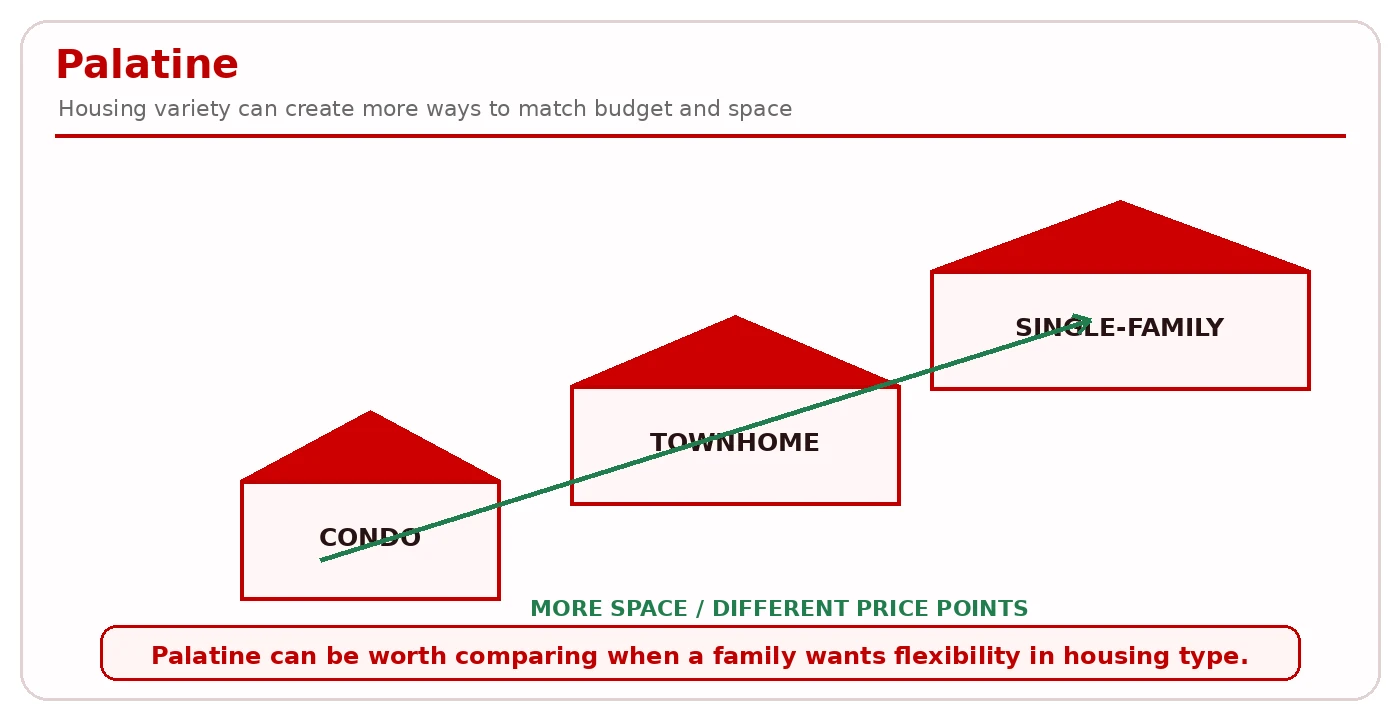
Palatine stands out for its wide housing flexibility, making it an excellent comparison option for households navigating diverse budgets and life stages (see our broader analysis in the Best Chicago Suburbs for First-Time Homebuyers in 2026).
Whether you are looking for an affordable starter condominium, a modern multi-story townhome, or an established detached single-family home on a spacious lot, Palatine offers multiple distinct entry points. Its downtown Metra station (UP-NW line) provides convenient commuting into the city, while Route 53 and Northwest Highway connect residents easily to surrounding shopping centers.
Housing Ladder
Broad spectrum from entry condos to move-up townhomes and custom single-family residences.
Price Flexibility
Provides multiple price thresholds, enabling buyers to stay within comfortable debt-to-income limits.
Commuter Transit
Palatine Metra station on UP-NW rail, paired with direct north-south connectivity along Route 53.
Established Amenities
Downtown dining district, Palatine Park District community centers, and Harper College campus nearby.
5. Mount Prospect
Routine PredictabilityA practical comparison point for northwest Chicago homebuyers.
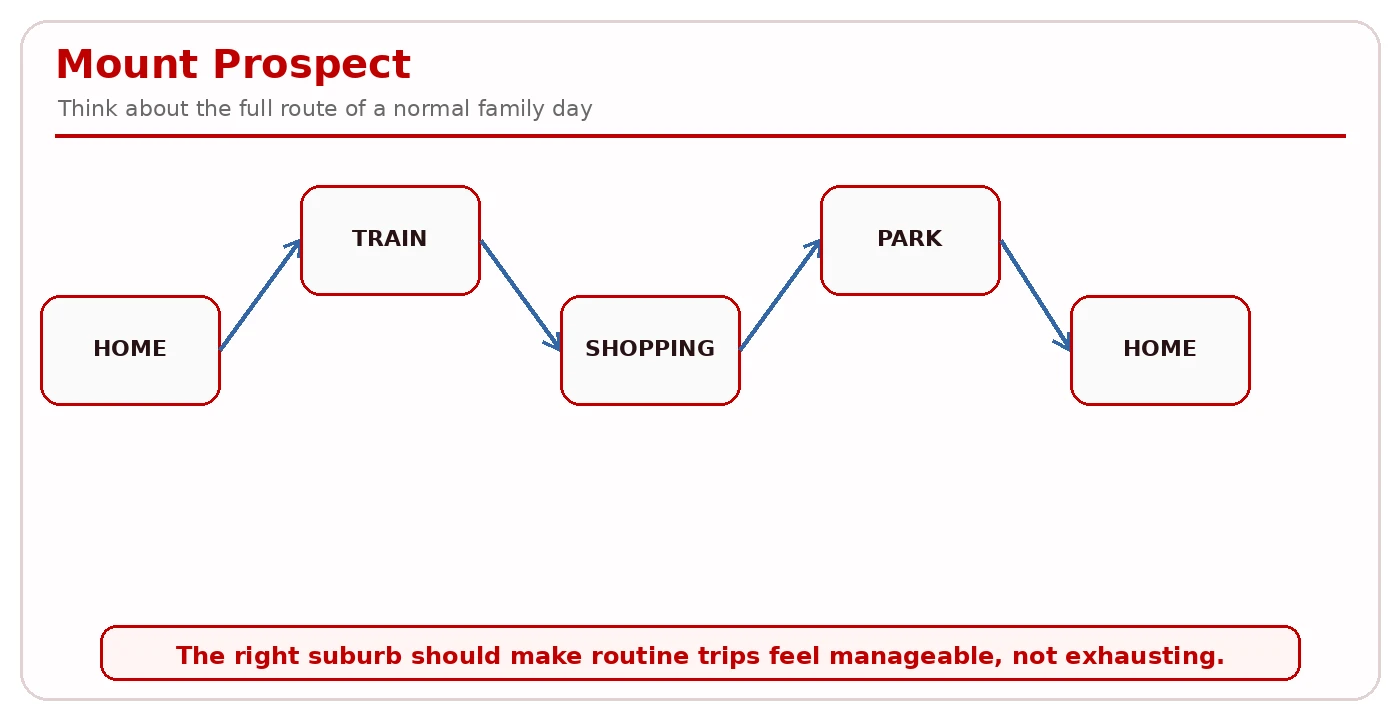
Mount Prospect excels for households prioritizing a predictable, low-friction daily routine. Positioned just southeast of Arlington Heights and northwest of Des Plaines, it offers established residential neighborhoods with solid housing stock, mature landscaping, and straightforward road corridors.
Its downtown Metra station (UP-NW line) anchors a revitalized village core with local dining and civic services, while Randhurst Village to the north provides major retail, entertainment, and dining anchors. For buyers, the key is evaluating the whole door-to-door weekday routine: home to daycare/school, workplace, errands, and back home.
Established Housing
High proportion of well-constructed mid-century brick ranches, split-levels, and traditional colonials.
Transportation Options
Mount Prospect Metra station, easy connections to Northwest Highway, Elmhurst Road, and I-90.
Retail Convenience
Randhurst Village, downtown local shops, grocery anchors, and nearby Des Plaines retail corridors.
Everyday Living
Low-stress errands, predictable school routes, and manageable commute times into Chicago or nearby suburbs.
6. Hoffman Estates
Value & SpaceA practical comparison point for northwest Chicago homebuyers.
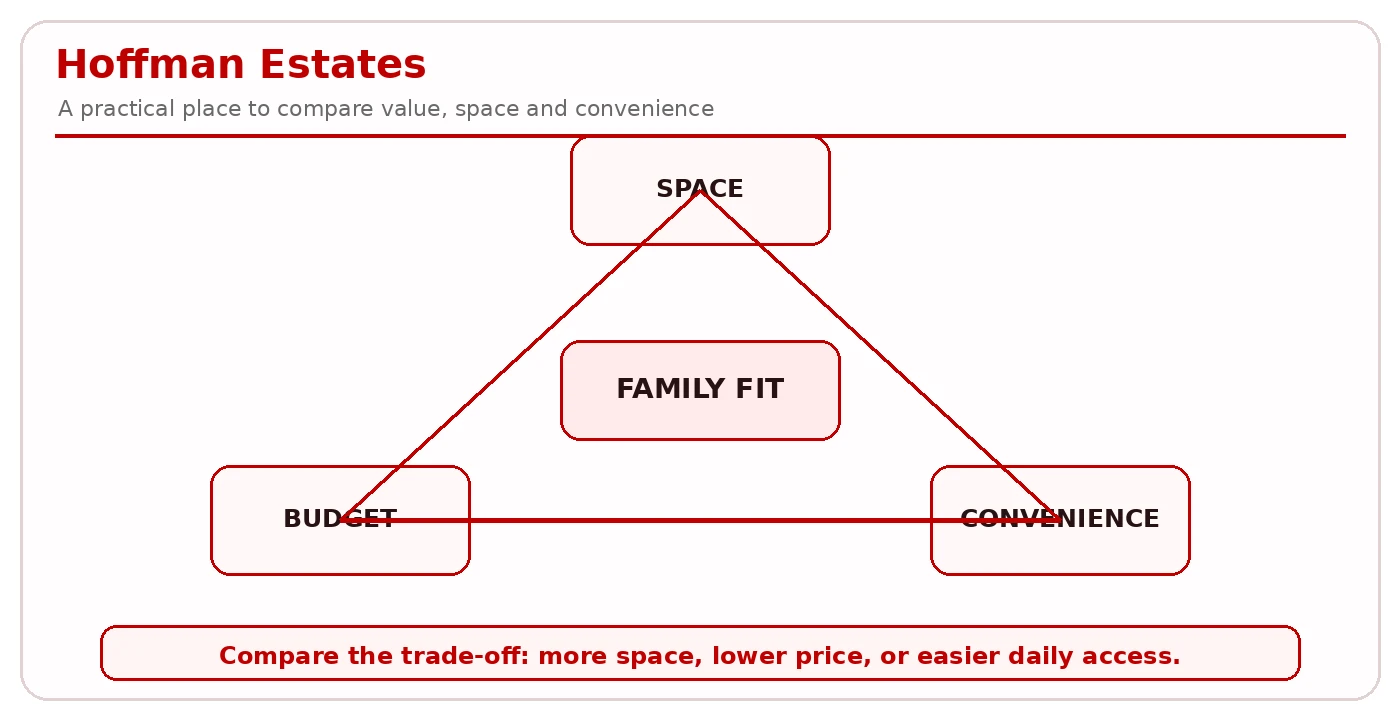
Hoffman Estates is naturally compared alongside Schaumburg because the two villages share municipal borders, commercial districts, and many civic services. However, Hoffman Estates often delivers different combinations of square footage, lot size, and price points.
Families looking for larger yard space or newer subdivisions often find compelling options here, particularly in the western areas near the NOW Arena, Poplar Creek, and the vast Paul Douglas Forest Preserve. As explored in our comparative analysis Schaumburg vs Hoffman Estates: Which Is Better for You?, buyers should compare total monthly carrying costs rather than assuming list price alone determines affordability.
Space & Square Footage
Opportunities for larger floor plans, generous backyards, and modern multi-level layouts.
Value Comparison
Often offers an attractive space-to-price ratio when compared to neighboring eastern suburbs.
Preserves & Outdoor Life
Direct access to Paul Douglas Forest Preserve, equestrian trails, and extensive paved cycling loops.
Regional Roadways
Immediate access to I-90 interchanges, Higgins Road (Route 72), and Golf Road (Route 58).
7. Elk Grove Village
Regional AccessA practical comparison point for northwest Chicago homebuyers.
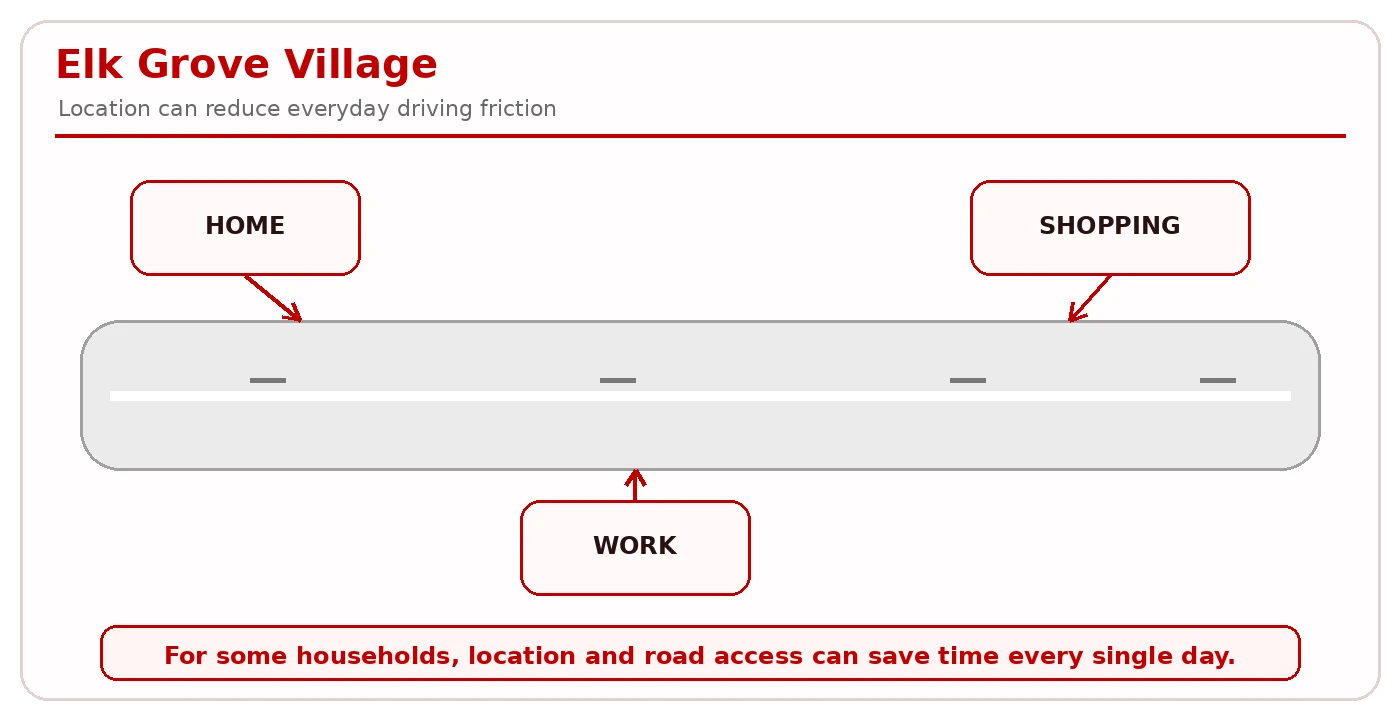
Elk Grove Village offers a compelling combination of quiet, tree-lined residential enclaves and unmatched regional accessibility. Situated just west of O’Hare International Airport and bordered by major expressway arteries, it provides some of the shortest drive times to major corporate corridors across Cook and DuPage counties.
The residential portion of the village is separate from its famous industrial business park, giving residential neighborhoods a classic, self-contained suburban atmosphere. Residents enjoy community amenities like Rainbow Falls Waterpark, the Pavilion Fitness Center, and direct proximity to Busse Woods, where wild elk roam in an enclosed preserve.
Highway Network
Unrivaled access to I-290, I-390 (Elgin O’Hare Tollway), Route 53, and I-90.
Established Subdivisions
Cohesive mid-century neighborhoods with manicured lawns, quiet street layouts, and community pride.
Parks & Forest Access
Southern border to Ned Brown Preserve (Busse Woods), Elk Pen viewing, and municipal park facilities.
Employment Proximity
Fast daily commutes to O’Hare area employers, Schaumburg corporate centers, and western suburban jobs.
8. Vernon Hills
Northern CorridorA practical comparison point for northwest Chicago homebuyers.
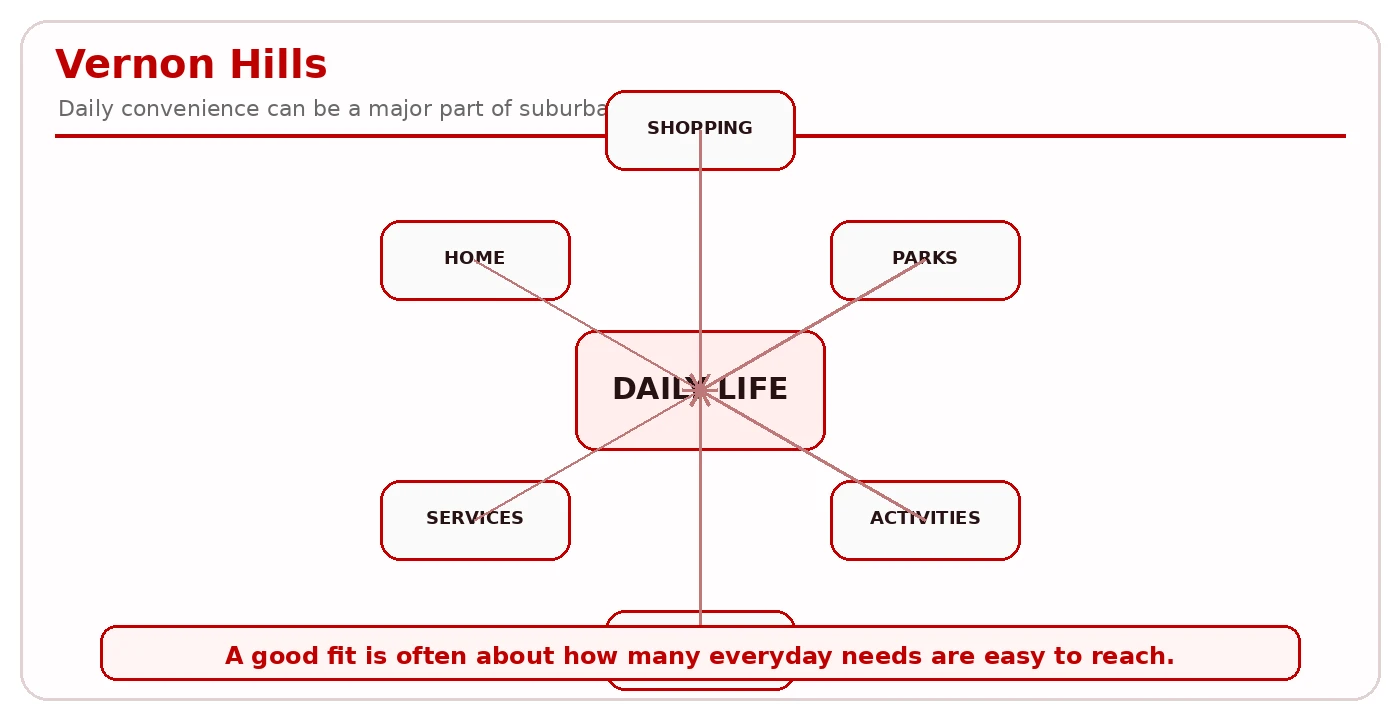
Vernon Hills is frequently considered by households willing to broaden their search northward into central Lake County. The village is known for its master-planned residential subdivisions, extensive retail clusters (including Hawthorn Mall and surrounding centers), and an abundance of municipal parks and sports facilities.
Because Vernon Hills sits further north than Cook County communities like Schaumburg or Mount Prospect, the primary tradeoff is commute distance to downtown Chicago or O’Hare. Buyers should weigh what they gain in neighborhood design, recreation, and commercial density against the extra weekday travel time required.
Planned Communities
Modern subdivisions with cohesive architecture, sidewalks, retention lakes, and park integration.
Retail Corridor
Hawthorn Mall, Mellody Farm, major grocers, big-box retail, and specialty dining within minutes.
Recreation Density
Century Park arboretum, Sullivan Community Center, Family Aquatic Center, and Vernon Hills Golf Course.
Commute Tradeoff
Metra North Central Service (NCS) station offers rail access, but driving into Chicago requires Route 60 / I-94.
How to Compare the Best Northwest Chicago Suburbs for Your Household
Use the same five questions everywhere you look.
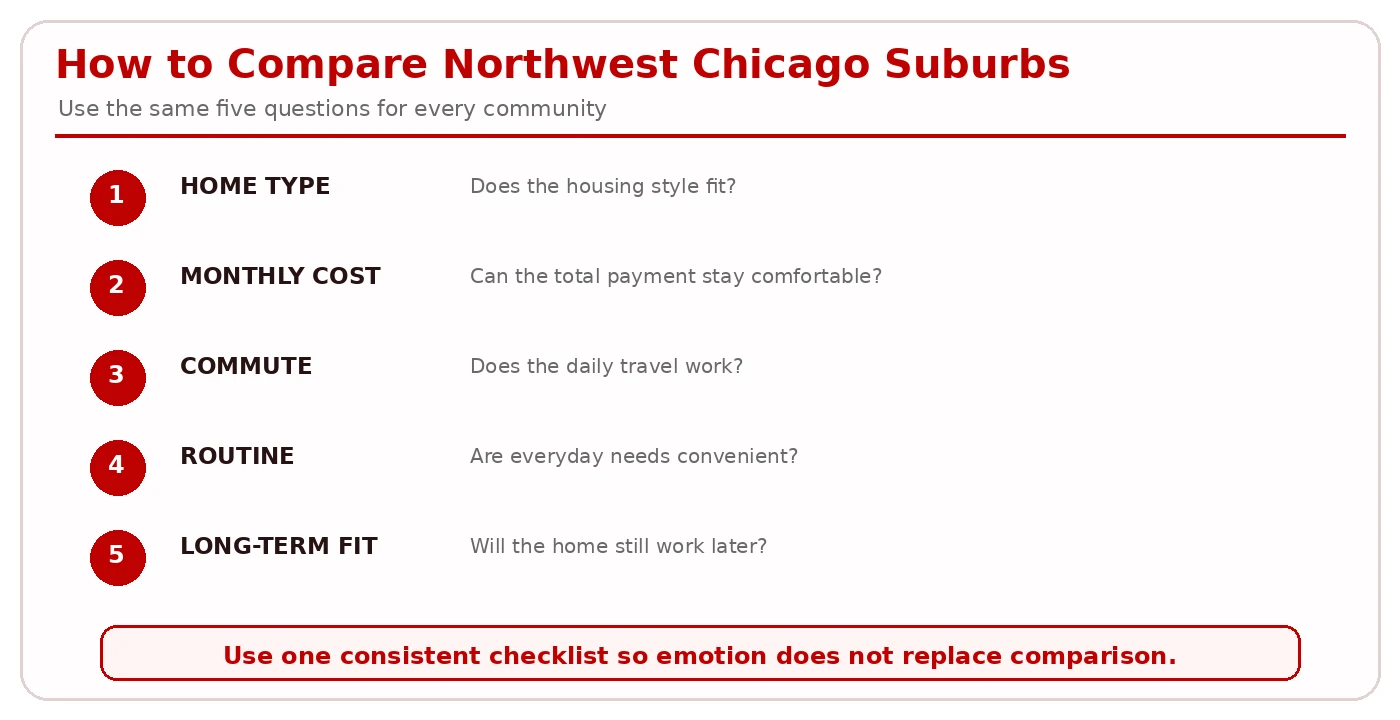
A disciplined comparison prevents buyers from becoming prematurely attached to one suburb before understanding their full spectrum of alternatives. When touring homes across Schaumburg, Arlington Heights, Buffalo Grove, Palatine, Mount Prospect, Hoffman Estates, Elk Grove Village, or Vernon Hills, hold every property to the same five questions:
The 5-Point Suburb Comparison Framework
Objective Criteria| Decision Factor | Core Question | What to Evaluate |
|---|---|---|
| 1. Home Type | Does the housing style fit your daily routine? | Single-family vs townhome vs condo; storage capacity, garage spaces, yard maintenance responsibilities. |
| 2. Monthly Cost | Can the total payment stay comfortable? | Principal, interest, actual property taxes, homeowners insurance, HOA fees, and near-term capital repair reserves. |
| 3. Commute | Does the daily travel work on normal weekdays? | Rush-hour drive times, Metra rail train frequency, station parking availability, and airport transit. |
| 4. Daily Routine | Are everyday errands and activities practical? | Distance to groceries, pediatrician, fitness centers, parks, youth sports, and family activities. |
| 5. Long-Term Fit | Will this home still work as your household evolves? | Layout flexibility over 3, 5, and 10 years, work-from-home space, multi-generational needs, and resale liquidity. |
Do Not Compare Suburbs by Purchase Price Alone
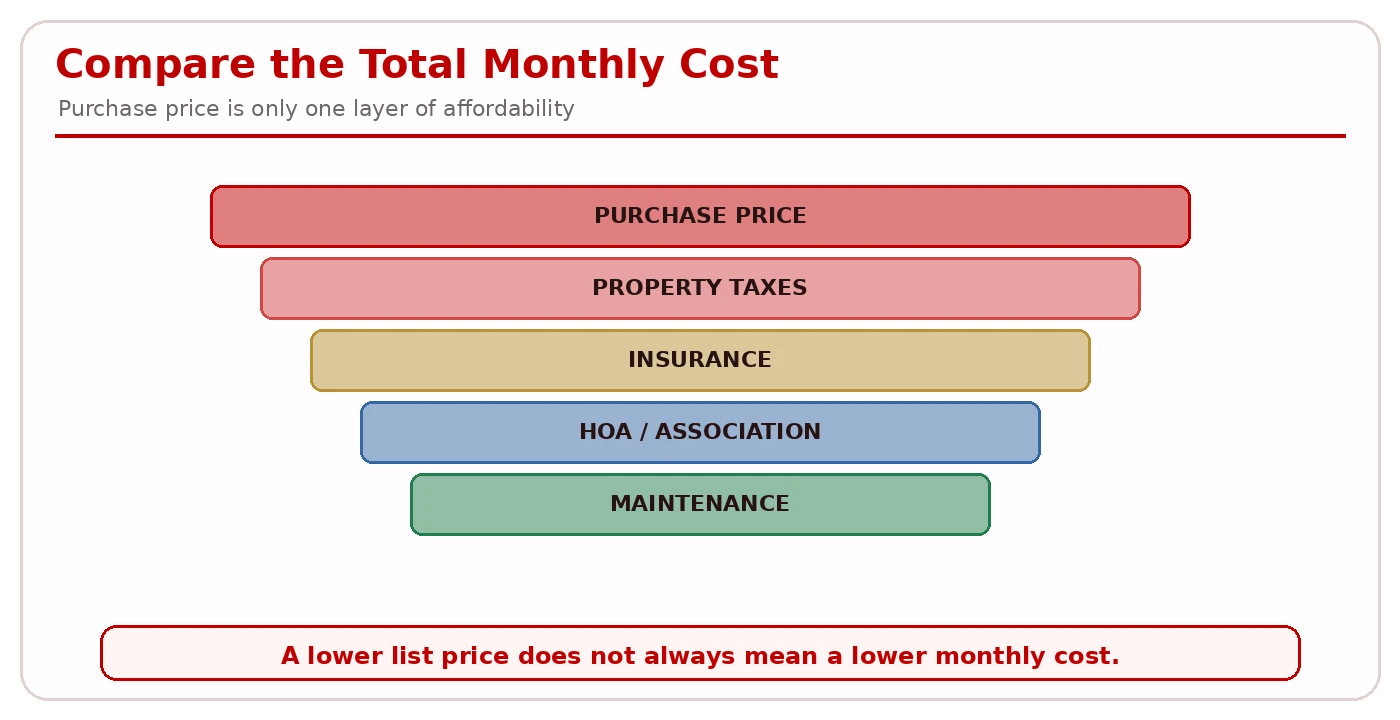
Total monthly ownership cost is the better affordability test.
One of the costliest traps for suburban homebuyers is comparing towns strictly by median sales prices or listing prices. In Illinois, property taxes and association fees vary substantially from town to town—and even between subdivisions in the same village. (Learn how to assess this with our guide to Comparing Chicagoland Property Taxes and our breakdown on How Much House Can You Afford in the Chicago Suburbs?).
Hypothetical Comparison: $425,000 vs. $440,000 Purchase
Illustrative ExampleNotice: This is a simplified hypothetical scenario to illustrate how non-mortgage factors shape real monthly payments. It does not represent actual live rates or current property guarantees.
Home A: Lower Purchase Price
$425,000 List Price
- Mortgage P&I (estimated): $2,240/mo
- Higher annual property taxes: $850/mo
- Homeowners insurance: $140/mo
- HOA / Townhome assessment: $320/mo
- Total Monthly Outlay: ~$3,550/mo
Home B: Higher Purchase Price
$440,000 List Price
- Mortgage P&I (estimated): $2,320/mo
- Moderate annual property taxes: $620/mo
- Homeowners insurance: $140/mo
- No HOA fee (Detached Single-Family): $0/mo
- Total Monthly Outlay: ~$3,080/mo
Key Insight: Home B has a \$15,000 higher sticker price, yet costs nearly \$470 LESS per month to live in. Always evaluate total monthly carrying cost before deciding which suburb offers “better value.”
The complete monthly ownership stack includes:
Test the Commute and Daily Family Routine
A great house can still be the wrong location.
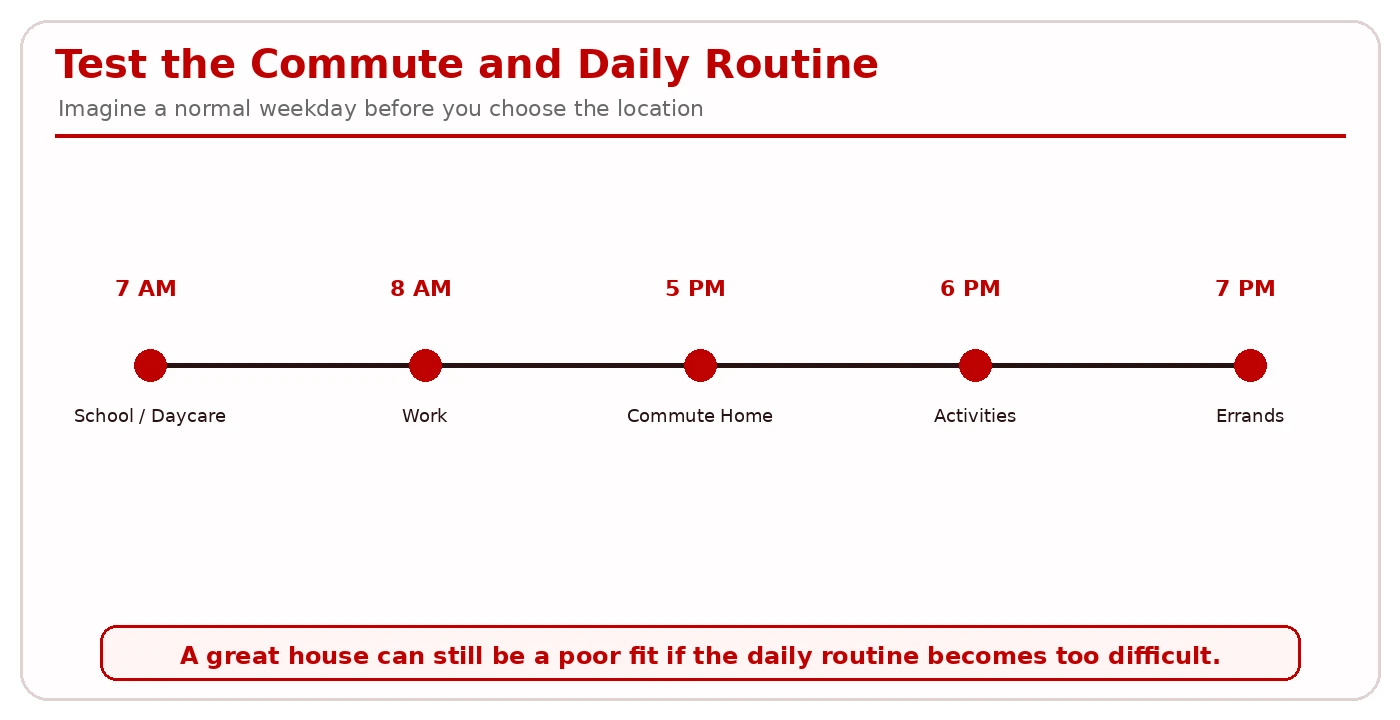
Before deciding that a suburb works for your family, map out a full normal weekday on paper. Think beyond the morning commute to the office. A family’s real routine involves multi-stop trips: morning school or daycare drop-offs, workday travel, after-school youth activities, grocery runs, pediatric appointments, weekend visits to relatives, and late-evening returns.
The 7-Stop Weekly Circuit Test
Test drive these key routes during actual peak hours (Tuesday morning and Thursday evening) before submitting an offer:
Think About 3, 5 and 10 Years — Not Only Move-In Day
A home purchase should support both current and future needs.
Families often focus intently on what feels comfortable right now. But a home purchase usually lasts much longer than a one-year apartment lease. Moving involves real closing costs, transfer taxes, inspection fees, and physical disruption.
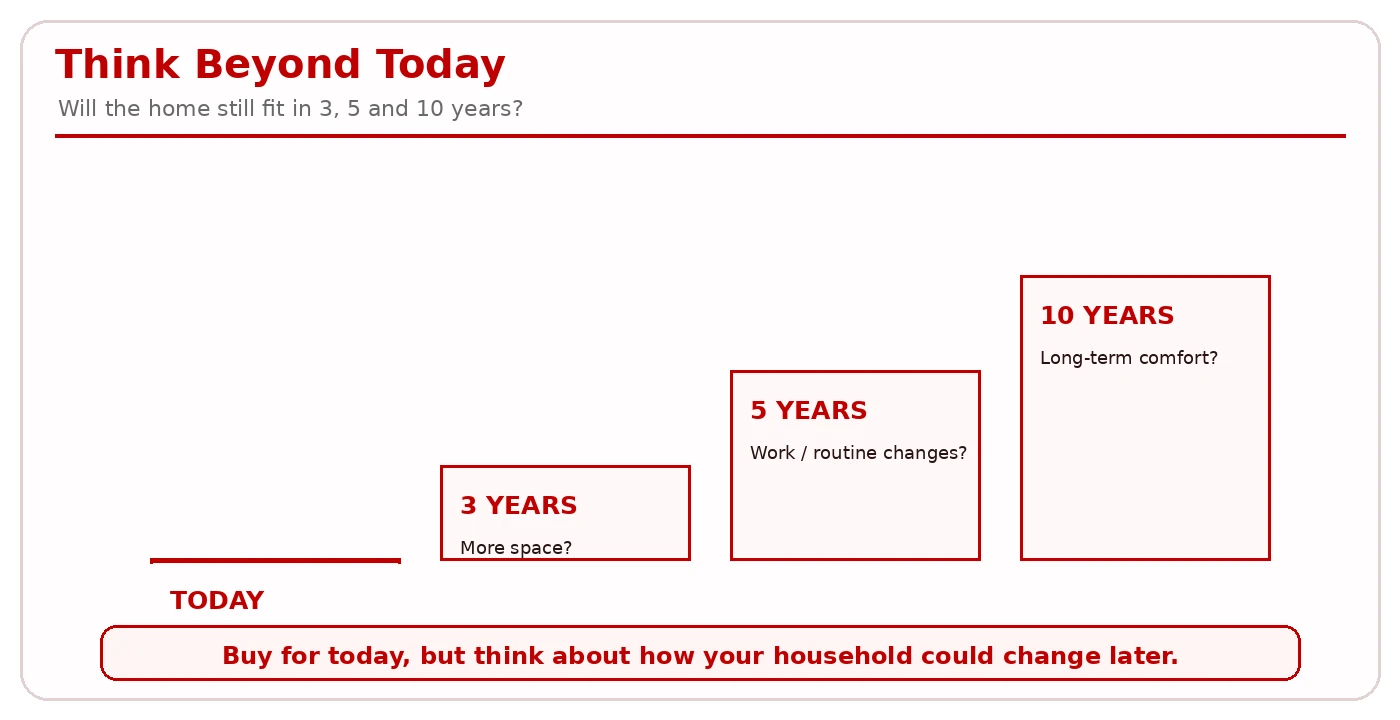
Ask whether the property’s floor plan, storage capacity, parking spaces, yard, and maintenance requirements could still make sense if your work schedules shift, your household grows, or family members come to stay:
Immediate Fit
Comfortable monthly mortgage, move-in readiness, manageable initial repairs, and quick acclimation to neighborhood routines.
Expanding Needs
Storage flexibility for sports equipment or hobbies, dual home-office capabilities, and outdoor play space as children grow.
Long-Term Horizon
Multi-generational adaptability (main-level bedroom/bath), predictable capital replacement cycles, and strong resale appeal.
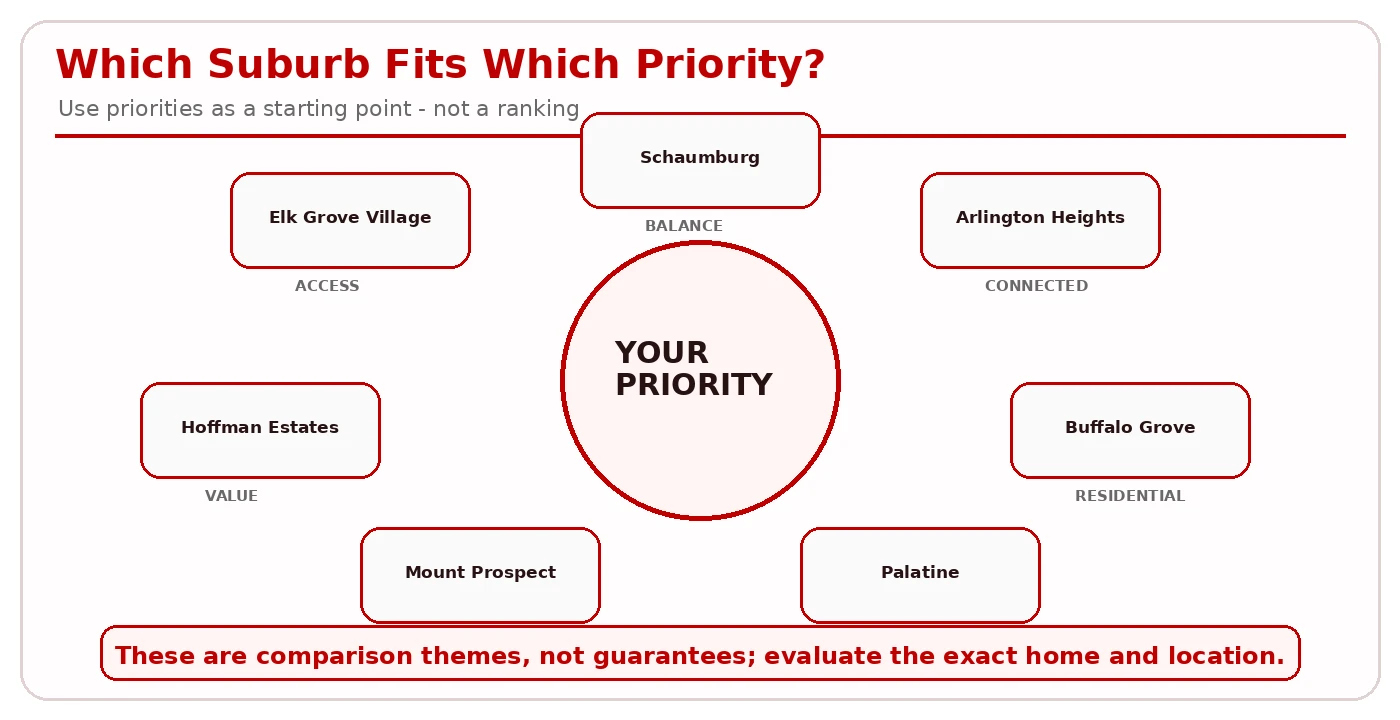
Which Northwest Suburb Should You Start With?
Use priorities as a starting point, not a rigid ranking.
Rather than visiting dozens of open houses across all eight communities simultaneously, start by pairing your primary lifestyle priorities with matching suburban themes:
Schaumburg & Palatine
Start here if you want multiple housing formats (condo, townhome, single-family), extensive retail choices, and flexible price points across northern Cook County.
Arlington Heights & Mount Prospect
Start here if you prioritize walkable downtown dining, civic atmosphere, and express rail service into downtown Chicago via the UP-NW Metra line.
Buffalo Grove & Hoffman Estates
Start here if you want quiet residential subdivisions, abundant parks and forest preserves, or larger floor plans for your monthly budget.
Elk Grove Village & Vernon Hills
Elk Grove Village delivers peak regional expressway access near O’Hare, while Vernon Hills opens up master-planned Lake County living with extensive commercial anchors.
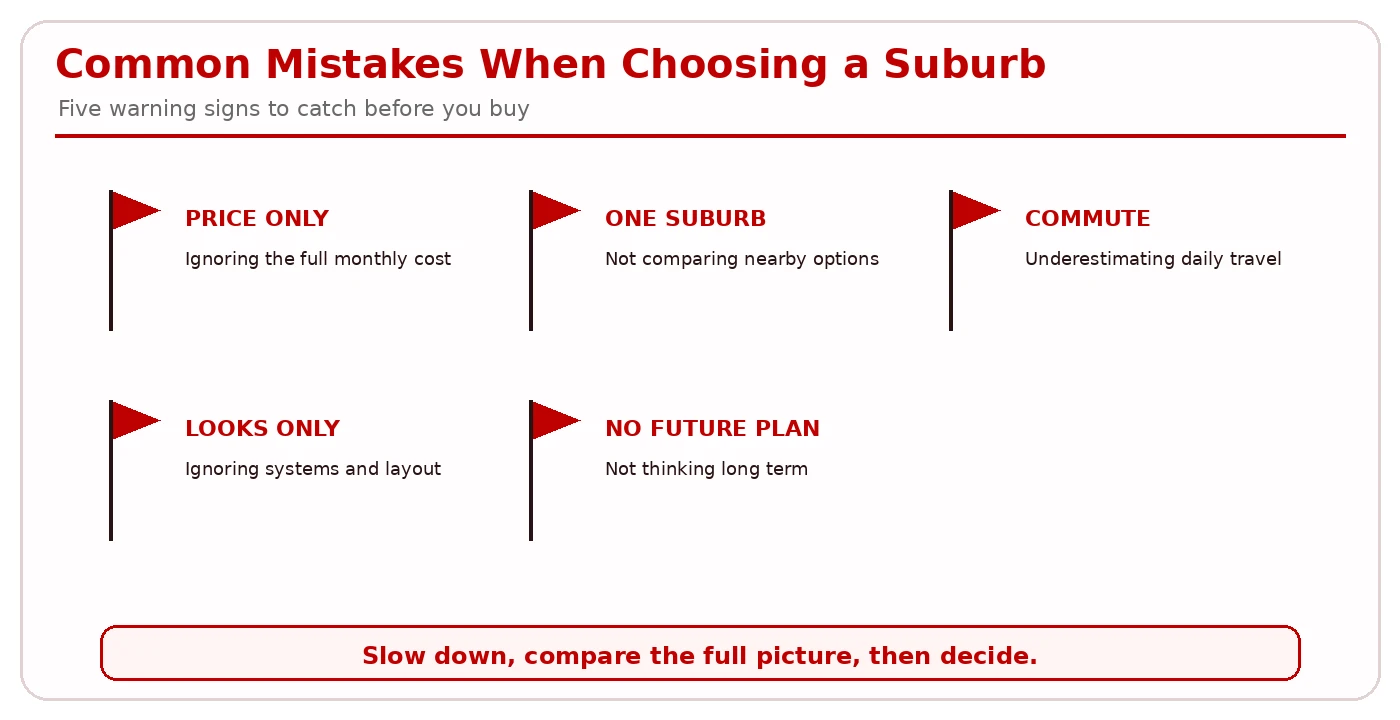
Five Common Mistakes Families Make When Choosing a Suburb
Avoid these shortcuts before making a major purchase commitment.
None of these mistakes guarantees a bad purchase, but each one introduces friction, unexpected costs, or buyer regret later on:
Comparing Only List Prices Instead of Total Monthly Carrying Cost
Ignoring differences in Cook vs. Lake County property taxes, special assessments, and HOA dues will distort which home is genuinely affordable.
Falling in Love With One Suburb Before Viewing Nearby Alternatives
Buyers often fixate on a single town name and overlook a virtually identical home two miles away across village borders that costs $400 less per month.
Underestimating Cumulative Daily Driving and Routine Travel
Testing only the morning highway drive on a Sunday afternoon overlooks the real-world friction of weeknight school, sports, and grocery traffic.
Focusing on Cosmetic Finishes While Ignoring Layout & Major Systems
Paint, quartz counters, and staging look great in listing photos, but an aging furnace, 20-year-old roof, or awkward floor plan cannot be fixed with decor.
Choosing Only for Today Without Considering 3 to 5-Year Flexibility
Buying a property that barely fits your current lifestyle leaves zero cushion if household size increases, careers shift, or space needs expand.
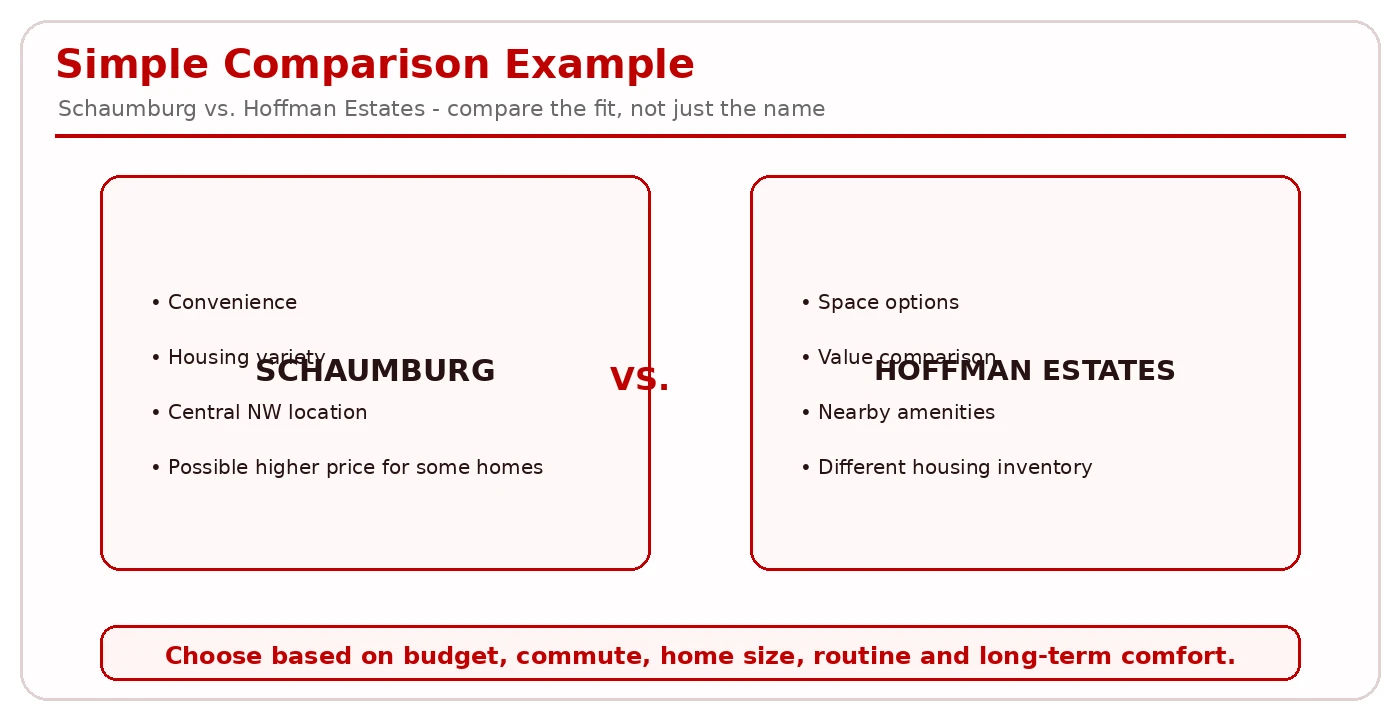
Simple Comparison Example: Schaumburg vs. Hoffman Estates
The better choice depends on the whole household plan.
To see how this decision framework works in practice, consider two neighboring communities that share borders and roads: Schaumburg and Hoffman Estates. For an exhaustive, head-to-head deep dive, read our dedicated comparison: Schaumburg vs Hoffman Estates: Which Is Better for You?.
Schaumburg Focus
Convenience Anchor- Commercial Hub: Immediate proximity to Woodfield Mall, Streets of Woodfield, and extensive retail options.
- Housing Choices: Broad spectrum of attached condos, multi-level townhomes, and detached homes.
- Central Location: Positioned at the regional crossroads of I-90, I-290, and Route 53.
- Tradeoff: Some properties carry higher density or slightly higher price per square foot.
Hoffman Estates Focus
Space & Value- Lot & Home Size: Often delivers larger yard footprints and newer subdivision layouts.
- Forest Preserves: Direct access to Paul Douglas Forest Preserve, Poplar Creek, and equestrian paths.
- Value Ratio: Can offer compelling square-footage-for-the-price comparisons.
- Tradeoff: Farther drive to Metra rail stations in western parts; multiple school district boundaries.
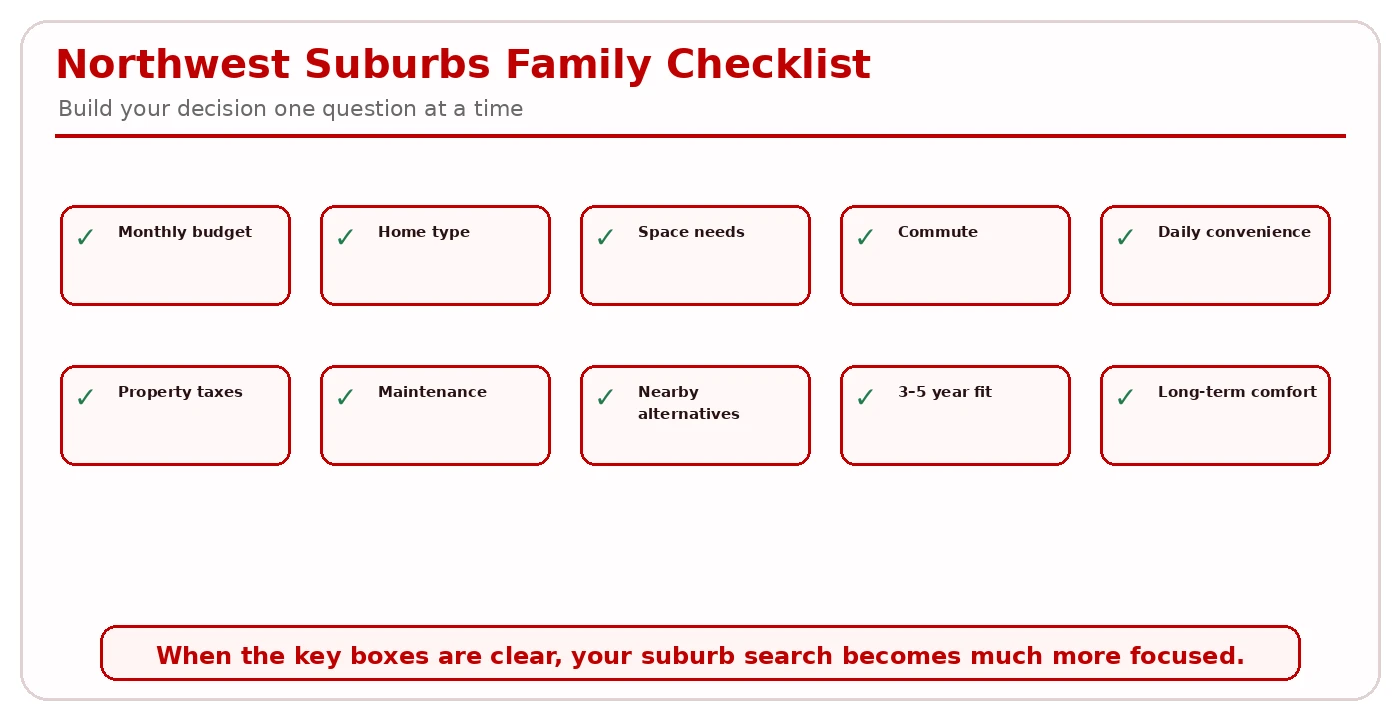
Northwest Chicago Suburbs Family Checklist
Use this interactive 10-point checklist before becoming serious about a specific home.
Important Fair Housing & Educational Note
This guide is for general educational and relocation-planning purposes. It compares practical factors such as housing options, transportation, parks, services, property costs and household routines. It does not rank communities based on protected characteristics or steer buyers toward or away from neighborhoods based on family status, race, religion, national origin, disability or other protected classes. Buyers should independently evaluate any schools, services or community characteristics important to them using neutral, authoritative sources.
Ready to Explore the Northwest Chicago Suburbs?
Homes by Bhargav helps buyers compare homes and communities across Chicagoland using the factors that matter in real life: budget, property type, commute, condition, taxes, location and long-term fit.
If you are deciding between Schaumburg, Arlington Heights, Buffalo Grove, Palatine, Mount Prospect, Hoffman Estates, Elk Grove Village, Vernon Hills or nearby communities, start with your household priorities and build your search with clarity.
Bhargav Shah, REALTOR®
Licensed Real Estate Professional • Homes by Bhargav
Phone: (510) 203-9270 • Website: HomesByBhargav.com