



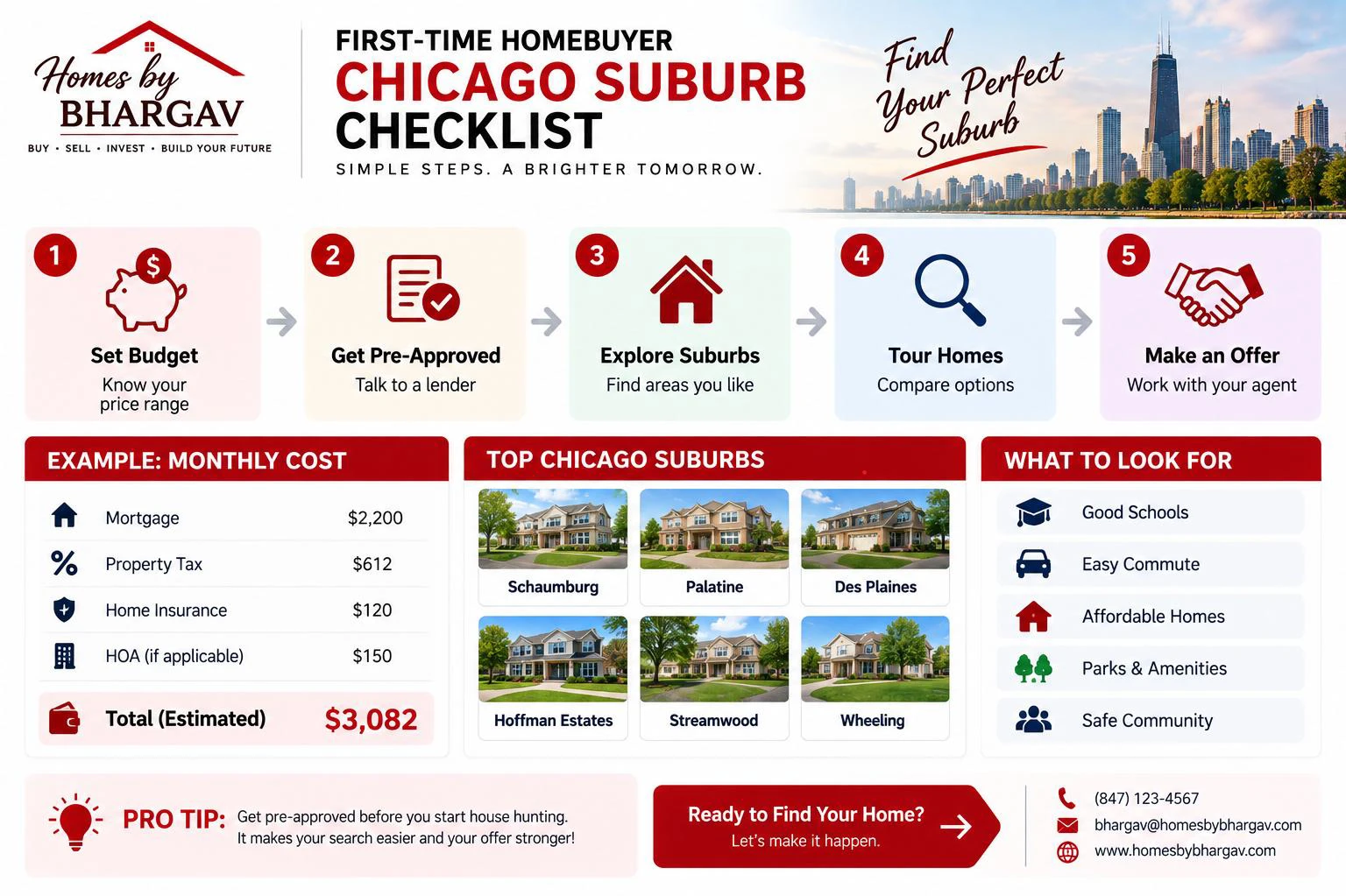
Buying Your First Home in Chicagoland: Start With the Right Suburb
Buying your first home is not simply a search for the lowest list price. In the Chicago suburbs, the better decision usually comes from balancing your monthly payment, property taxes, commute, housing type, maintenance expectations, neighborhood fit and long-term plans.
In 2026, that comparison matters even more because nearby suburbs can behave very differently. Recent market data shows meaningful differences in median sale prices and competition across communities such as Schaumburg, Palatine, Des Plaines, Hoffman Estates, Streamwood and Wheeling. The goal of this guide is not to declare one suburb universally “best,” but to help first-time buyers identify where their budget and lifestyle may fit best.
2026 Buyer Reality vs. What to Do
Homes by Bhargav Buyer Principle
“Compare the full cost of ownership and the day-to-day lifestyle — not just the asking price.”
2026 Market Snapshot: Suburbs Worth Comparing
The table below uses recent 2026 market data as a starting point. Market conditions change, and a citywide median does not describe every neighborhood, school boundary, condo association or individual property. Use these numbers for orientation, then evaluate current listings and comparable sales before making an offer.
| Suburb | Recent 2026 Median Sale Price* | Typical Buyer Angle | Watch Closely |
|---|---|---|---|
| Streamwood | ~$330K | Lower entry point among this comparison set | Competition, condition and taxes |
| Schaumburg | ~$373K | Broad mix of condos, townhomes and single-family options | Property type, HOA and taxes |
| Palatine | ~$395K | Established suburb with varied housing stock | Competition and neighborhood-by-neighborhood pricing |
| Des Plaines | ~$405K | Location and transportation access can appeal to commuters | Taxes, flood considerations where applicable, property condition |
| Hoffman Estates | ~$410K | Suburban housing variety and access to major employment corridors | Competition, taxes and maintenance |
| Wheeling | ~$317K | Potentially approachable price point in the north/northwest suburbs | Inventory, property type and HOA where applicable |
*Approximate recent market medians are time-sensitive and are included for educational comparison, not as a valuation of any specific home.
1. Schaumburg: A Strong All-Around Search Area
Schaumburg is often worth comparing when a first-time buyer wants access to a large suburban employment base, shopping, restaurants and multiple housing formats. Recent 2026 data places the median sale price in the upper-$300,000 range, but condos and townhomes can create different entry points than detached homes. For more localized market insights, explore our dedicated Schaumburg real estate guide.
What first-time buyers should check:
- • Compare HOA dues and reserves carefully on attached housing.
- • Review property taxes as part of the monthly payment, not as an afterthought.
- • Decide whether proximity to work, highways and everyday amenities justifies paying more for a particular location.
2. Streamwood: A More Accessible Price Point
Streamwood has recently shown a lower median sale price than several nearby northwest suburbs. That can make it relevant for buyers whose priority is getting into homeownership without stretching toward a higher purchase price. For additional cost comparisons, see our analysis on the best Chicagoland suburbs for first-time buyers on a budget.
What first-time buyers should check:
- • Do not assume a lower purchase price means a lower total monthly cost — compare taxes and insurance.
- • Inspect older mechanical systems, roof, windows and deferred maintenance carefully.
- • Well-priced homes can still attract competition, so financing readiness matters.
3. Wheeling: North-Suburban Access at a Different Price Level
Wheeling can deserve a place on the shortlist for buyers who want north-suburban access while comparing a price point below some neighboring communities. Housing type matters: condos, townhomes and detached homes can produce very different monthly-cost profiles.
What first-time buyers should check:
- • Check HOA dues, special-assessment history and rental restrictions for attached properties (learn more about condo & townhome dues).
- • Compare commute routes at the actual time you expect to travel.
- • Review the specific property’s tax bill and exemptions rather than relying on general assumptions.
4. Palatine: Housing Variety With a Competitive Market
Palatine offers a broad range of housing styles and neighborhoods. Recent 2026 data shows a median sale price around the high-$300,000s to roughly $400,000, and the market has remained competitive.
What first-time buyers should check:
- • Have a clear offer ceiling before entering a multiple-offer situation.
- • Compare neighborhoods and housing types rather than treating Palatine as one uniform market.
- • Factor future maintenance into the budget, especially for older single-family homes.
5. Des Plaines: Location Can Be the Value
Des Plaines may appeal to buyers who place a high value on access to employment centers, transportation and established neighborhoods. Recent market data shows pricing around the low-$400,000 range on a rolling basis, although individual areas and housing types vary significantly. Learn more about local buyer demand on our Des Plaines real estate page.
What first-time buyers should check:
- • Evaluate transportation convenience against property taxes and home condition.
- • Check flood-zone and insurance considerations for the specific property where relevant.
- • Condos can have very different HOA, reserve and special-assessment profiles — review documents before committing.
6. Hoffman Estates: Space, Access and Suburban Variety
Hoffman Estates offers a mix of housing and access to northwest-suburban employment and transportation corridors. Recent 2026 data places the median sale price a little above $400,000.
What first-time buyers should check:
- • Compare the age of major systems — roof, HVAC, windows and water heater — when evaluating value.
- • Keep taxes and possible HOA costs inside the affordability calculation.
- • Competition can be meaningful for attractive, correctly priced homes; prepare documents before you find the right property.
Other Chicagoland Suburbs to Keep on Your Radar
Depending on budget, commute and housing needs, first-time buyers may also compare communities such as Bartlett, Tinley Park, Oak Lawn, Elk Grove Village, Mount Prospect, Arlington Heights, Naperville or other parts of the northwest, western and south suburbs. Some of these markets may carry higher price points, while others can offer different tradeoffs in taxes, commute or housing stock. The right shortlist should come from your numbers and priorities. Explore our broader coverage across the region in Areas We Serve.
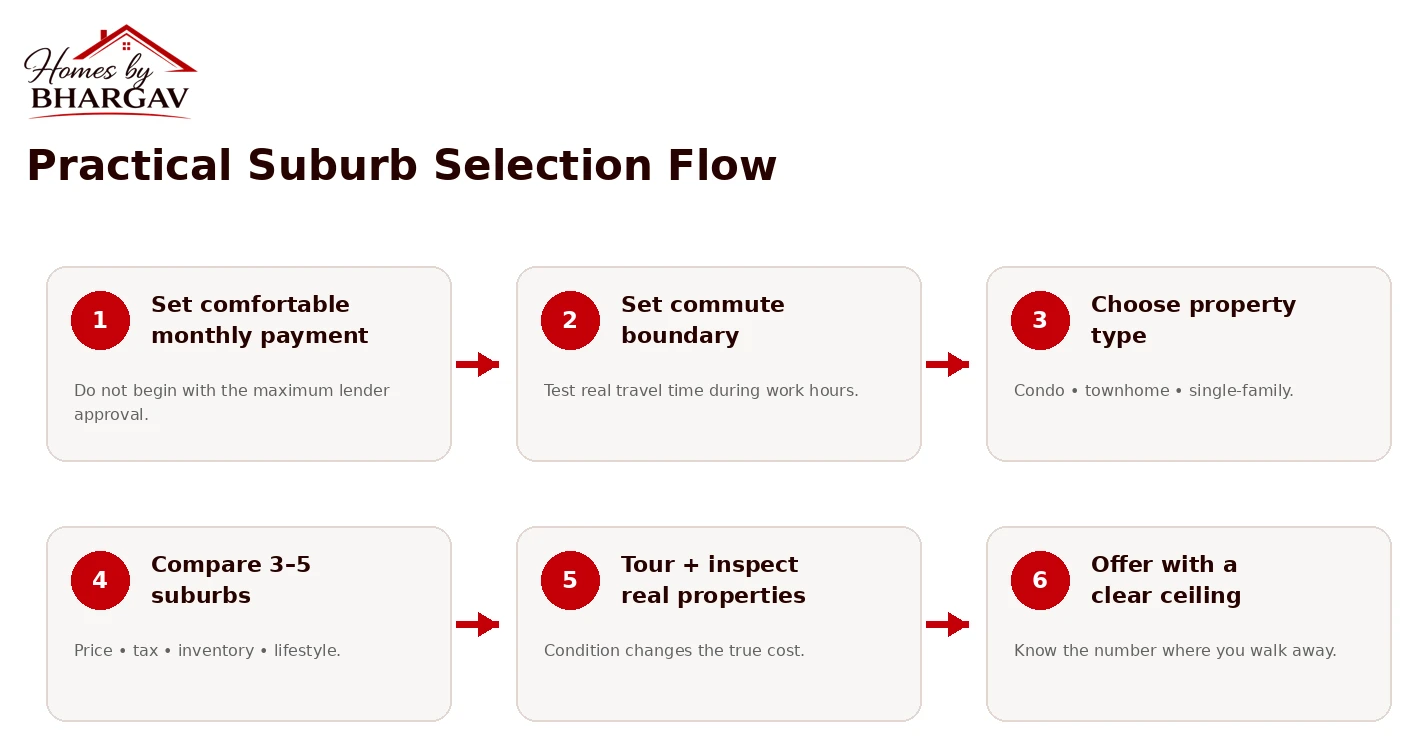
How to Choose the Right Chicago Suburb for Your First Home
1. Set a monthly comfort number
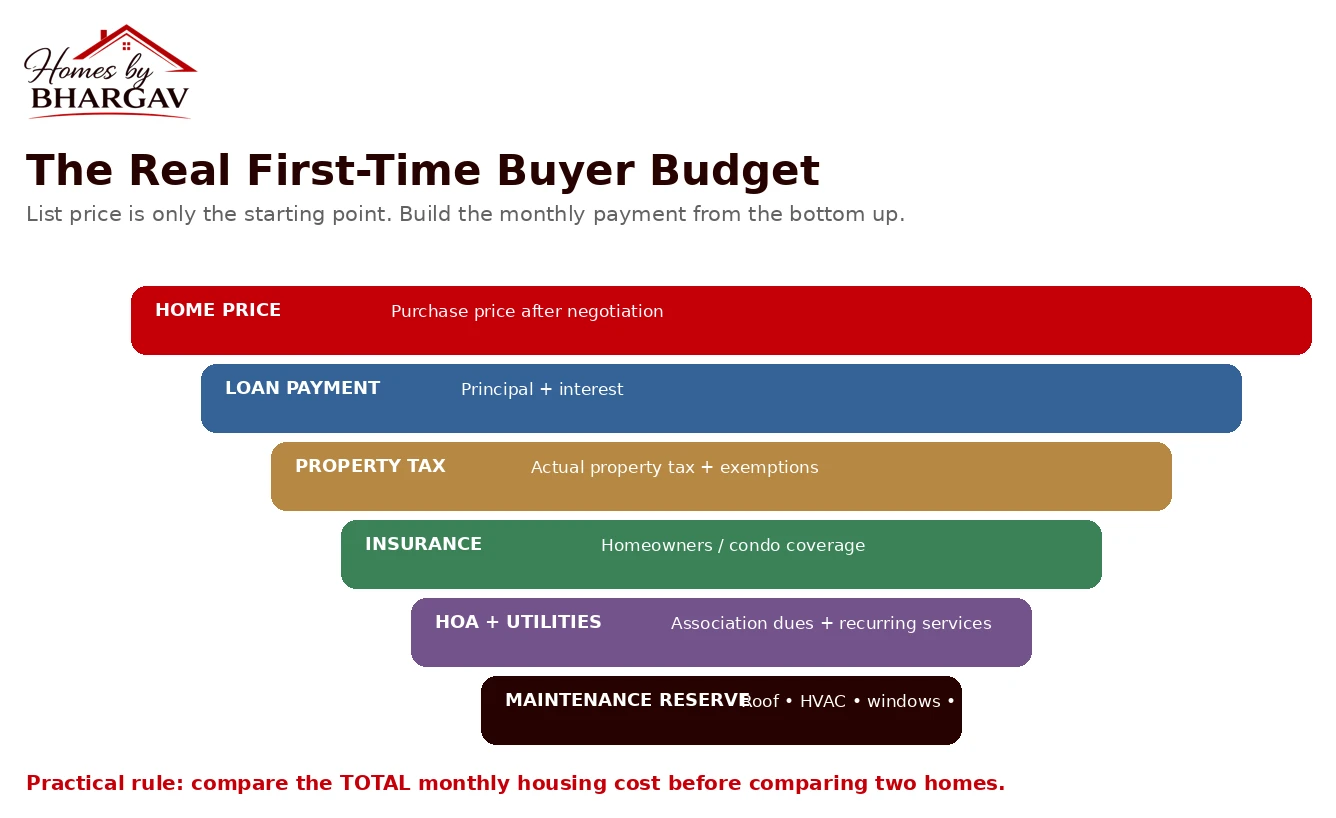
Start with the payment you can comfortably carry after including principal, interest, property taxes, homeowners insurance, HOA dues, utilities and a maintenance reserve.
2. Separate must-haves from preferences
Bedrooms, commute limit and property type may be true requirements. A finished basement, updated kitchen or oversized yard may be negotiable.
3. Compare taxes property by property
Illinois property taxes can materially change affordability. Review the actual tax bill, exemptions and possible reassessment implications with appropriate professionals.
4. Understand the HOA before buying attached housing
Review dues, reserves, rules, special assessments, insurance responsibilities and rental restrictions for condos and townhomes.
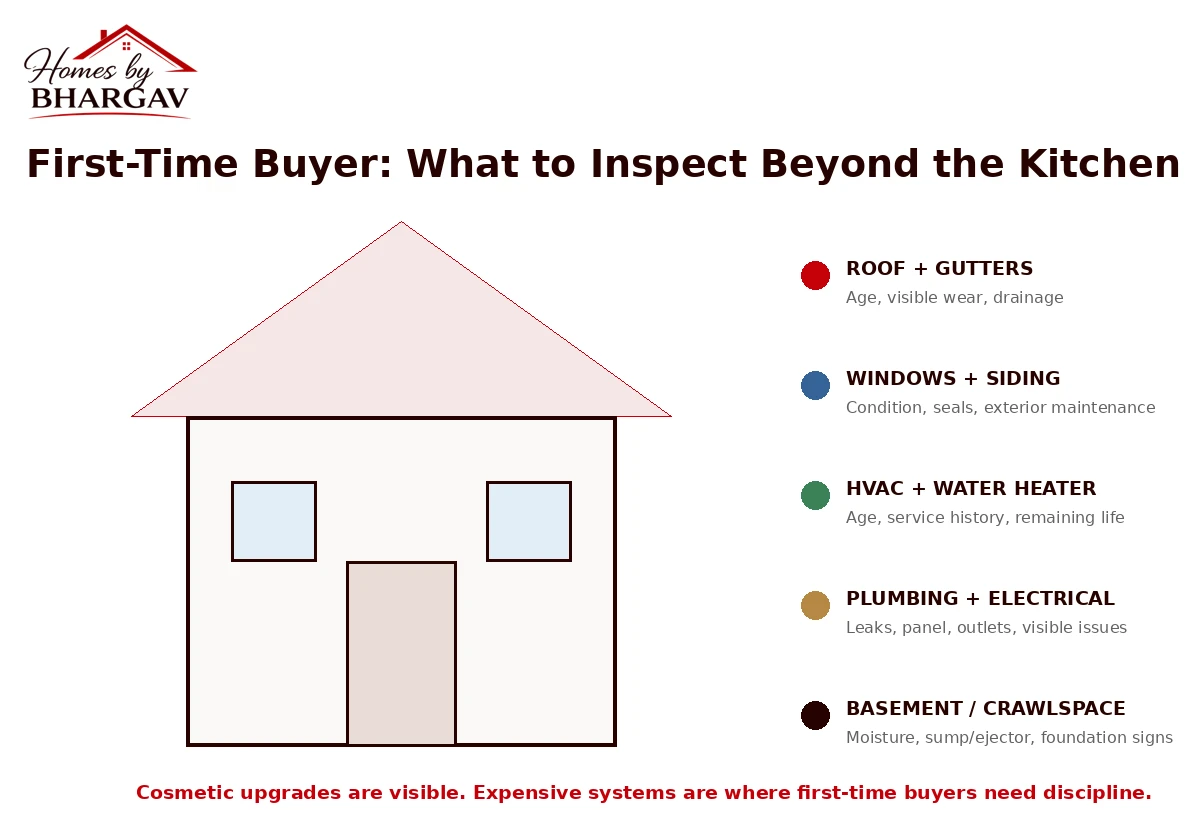
5. Inspect the expensive systems
Roof, HVAC/furnace, windows, water heater, plumbing, electrical, foundation/crawlspace and drainage can matter more to a first-time buyer’s budget than cosmetic finishes.
6. Test the commute in real life
Drive or use transit during the hours you will actually travel. A suburb that looks close on a map can feel very different during peak traffic.
7. Protect your future flexibility
Think about how long you expect to stay, whether your space needs may change and how easy the property may be to maintain or resell.
Practical Scenarios: How Two Similar Homes Can Cost Very Different Amounts
Example A — Lower price, higher carrying cost
A townhome may have a lower purchase price but a significant monthly HOA. A detached home may cost more upfront but have no association fee. Compare the complete payment before deciding which is truly more affordable.
Example B — Updated finishes, aging systems
A beautifully remodeled kitchen can distract from an older roof, furnace, air conditioner or windows. A first-time buyer should estimate near-term capital expenses before paying a premium for cosmetics.
Example C — Longer commute, lower price
Moving farther out may reduce the home price, but added fuel, tolls, train costs and commuting time can change the real value proposition. Test the commute before making the suburb decision.
First-Time Buyer Checklist Before You Make an Offer
- ✓Pre-approval is current and reflects your realistic monthly comfort level.
- ✓You have reviewed estimated taxes, insurance and HOA costs.
- ✓You understand the property’s age and major mechanical systems.
- ✓You have reviewed comparable recent sales with your real estate professional.
- ✓You know your offer ceiling before negotiations become emotional.
- ✓You understand inspection, attorney-review and financing timelines applicable to your transaction.
- ✓For condos/townhomes, you plan to review association documents, reserves and special assessments.
- ✓You have budgeted for closing costs, moving expenses and post-closing repairs — not only the down payment.

Common Mistakes First-Time Buyers Should Avoid
Shopping only by list price
A lower-priced home with higher taxes, HOA dues or deferred maintenance can cost more each month than a higher-priced alternative.
Waiting for a “perfect” house
Focus on the features that affect your daily life and finances. Cosmetic items can often be changed later.
Ignoring resale considerations
Even a first home should be evaluated for location, layout, condition and future buyer appeal.
Skipping professional due diligence
A strong purchase decision can involve your lender, attorney, inspector, insurance professional and real estate agent. Each has a different role.
Questions to Ask at Every Showing
- After closing, how much cash will remain for moving, furnishings, repairs and emergencies?
- What comparable properties recently sold nearby, and how does this home’s condition differ?
- Does the layout still work if your household or work-from-home needs change?
- Are there visible repairs that should be evaluated by the appropriate inspector or contractor?
- How long has the property been on the market, and have there been price changes?
- What are the current property taxes and which exemptions are reflected in that bill?
- What is included in the HOA fee and what remains the owner’s responsibility?
- For an HOA: what are the dues, reserves, recent special assessments and major upcoming projects?
- Are there known water-intrusion, drainage, sump-pump or foundation concerns?
- How old are the roof, furnace, air conditioner, water heater and windows?
A Practical 2026 Strategy
For many first-time buyers, the most effective approach is to choose three to five suburbs rather than searching all of Chicagoland. Build that shortlist around a realistic monthly budget and commute. Then compare active inventory, taxes, property condition and competition every week. This gives you enough flexibility to find value without losing focus.
Current 2026 data also reinforces why preparation matters. Several northwest suburbs continue to show competitive conditions, meaning attractive homes may receive multiple offers. A buyer who already understands financing, inspection priorities and negotiation limits can make a cleaner decision when the right property appears. Read our complete Chicagoland home buyer process for step-by-step guidance.
Ready to Start Your Chicagoland Home Search?
Homes by Bhargav helps buyers, sellers and investors navigate Chicago and the suburbs with local market guidance, clear communication and a strategy built around their goals.
For first-time buyers, the process can include narrowing the right suburbs, comparing properties, understanding local market conditions, preparing an offer and coordinating the transaction from search through closing.